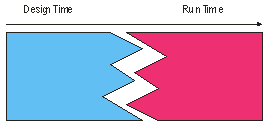
A form in ATEasy goes through several stages of existence, from its creation to its design, storage, loading, and unloading. These stages can be grouped into two major epochs of a form's life: "design time" and "run time."
Design time is where most of the work of creating the form takes place. In design time, you create a form within the Program, System or Driver Forms submodule, plan the layout of the form, populate the form with controls and menus, and write events. The form is saved as part of the module.
In run time, the form object variable is loaded and shown using the Load statement, and its controls are created. The procedures which you have written to the form's controls and menus are called, and the procedures can in turn, if needed, modify the properties of the form programmatically or call methods. (For example, a chart control can receive data from a lab instrument and alter the chart display accordingly.) A procedure can include code to unload the form, usually as the event linked to a final exit from the form. The Unload statement destroys the form window; to destroy the form object itself, you must equate it to nothing. This is the end of the form's life until it is invoked again.
Here are eight steps to create and load a sample form:
Step 1. Create the form.
(Use the Insert Below button  to insert a new form into the list of forms in the left-hand Explorer pane of the ATEasy window.)
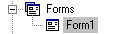
You will see the new form displayed in the ATEasy IDE:
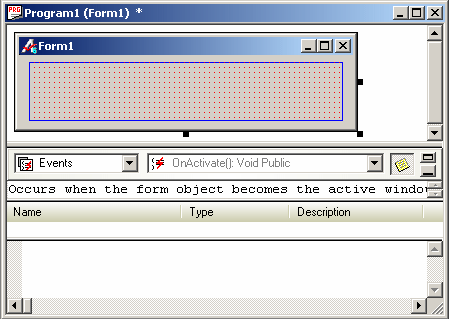
Step 2. Name the form SimpleForm in the Name box on the form property sheet.
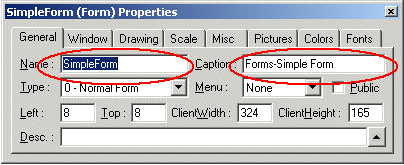
Note the difference between the Name and the Caption properties. The Name property gives the name by which the form will be referred to as a type of form variable; as an identifier, it is a single word, intercapitalized. The Caption property gives the "human-readable" name the form will display in the title bar; as such, it can contain spaces.
Step 3. Add controls and/or menus.
Select the AButton control  from the Controls toolbar. Click and drag in the form's client area to place and size the AButton control on the form.
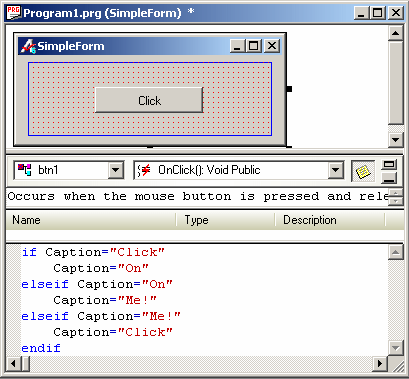
Step 4. Add form variables and procedures for events. Here, the OnClick() event is getting a procedure.
Step 5. Create a variable named frmSimple of type SimpleForm.
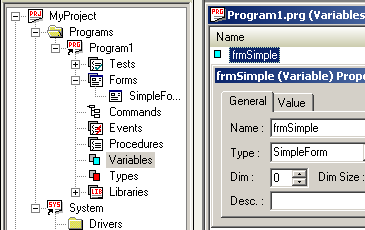
(Select the Variables icon  in the left-hand Explorer pane of the ATEasy window. Use the Insert Below button
  to insert a new variable into the list. Type 'simpleForm' as the type of the variable, with a lowercase initial letter. If you have correctly created the form, ATEasy will locate it and correctly reference it as 'SimpleForm." This auto-correction of capitalization is a good way to check your form. )
Step 6. In the Task window of the project, write a procedure that loads frmSimple.
Select the Tests icon  in the left-hand Explorer pane of the ATEasy window. Use the Insert Below button to insert a new task into the list. In the right-hand pane of the ATEasy window, examine the Task and Test windows. Select the new test ("Untitled Test") and rename it Example.
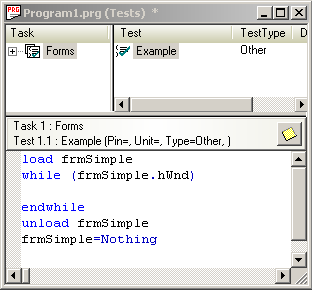
In the lowest blank text area under the Task and Test windows, enter the procedure that loads frmSimple.
Load frmSimple
Step 7. In that procedure, write code that allows frmSimple to remain displayed.
Load frmSimple
Unload frmSimple
frmSimple=Nothing
Now, you have entered a complete sequence to load the form and unload it once it is closed.
The program's steps really constitute the runtime life of a form:
A. Load and show the form (load frmSimple).
B. Close the form (unload frmSimple).
C. Destroy the form object (frmSimple=nothing).
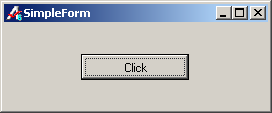
Step 8. Run the form using the FormIt!  icon.
icon.
The FormIt! icon should be visible and active in the top row of icons. In order for it to be active, the form must be in a project and the project must be Active; otherwise, the icon will be grayed out. See Set the Active Project. If you click on it, the form will load and will be shown.