
In ATEasy DotNet example, the classes DotNetClass1, DotNetClass2, and DotNetClass3 are declared as such:
DotNetClass2 is derived from DotNetClass1
DotNetClass3 is derived from DotNetClass2
And all have a virtual property and a virtual method called:
VirtualProp()
VirtualMethod()
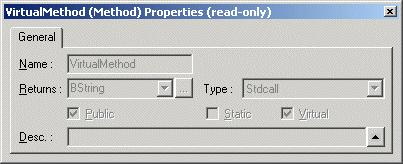
Notice that the flag 'Virtual' was checked in the property pages:
The following example shows that you can make the following assignment because cls1 and cls2 does belong to cls3:
cls3=new DotNetClass3()
cls2=cls3
cls1=cls3
Because VirtualProp() and VirtualMethod() are virtual, each call with different class evokes the same function:
! virtual props
s=cls3.VirtualProp()
if (s<>"DotNetClass3.VirtualProp" OR cls1.VirtualProp()<>s OR cls2.VirtualProp()<>s)
TestStatus=Fail
endif
! virtual methods
s=cls3.VirtualMethod()
if (s<>"DotNetClass3.VirtualMethod" OR cls1.VirtualMethod()<>s OR cls2.VirtualMethod()<>s)
TestStatus=Fail
endif