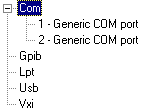
The Tools, Options menu allows the user to select a computer port and its settings.
In addition, a logical port is assigned to a physical port.
ATEasy provides features that allow you to port or move components from one test system to another. In addition, ATEasy provides unparalleled flexibility in terms of integrating a variety of instruments.
ATEasy supports three levels of driver configuration.
|
The Tools, Options menu allows the user to select a computer port and its settings. In addition, a logical port is assigned to a physical port. |
|
From the driver document window, you can select the supported interfaces through the Driver Properties dialog.
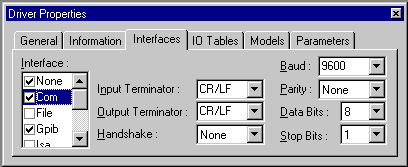
In this example, Com and Gpib are selected. This implies that the instrument can use either port to communicate with computer.
Next, you can modify the properties of the driver (from the workspace) to select the interface.
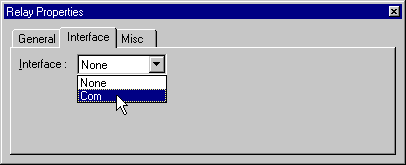
ATEasy takes care of the differences between interfaces, so the driver is interface-independent. In this way, ATEasy allows the user to change instruments without having to change the test programs. For example, if the test operator changes one DMM instrument for another, the test program does not have to be modified.
This enables code to be used across different test programs (and different departments in your company), faster development of test programs, and time savings in maintaining test programs.
The driver supports a level of isolation through the use of Driver commands. The Driver commands exist between test program and Driver procedures. While Driver procedures might vary from one DMM to another, the driver commands would not. For more information on commands, see Overview of Commands.
By removing dependency of every test program on driver related code, ATEasy can be used on different brands of test hardware. Flexible module code makes this possible. Instruments bundled with their own drivers are easily added to an ATEasy test system. ActiveX controls can be added for increased flexibility. This is especially helpful in performing statistical analysis of multiple test results. If necessary, test engineers can easily write their own drivers for new instruments.