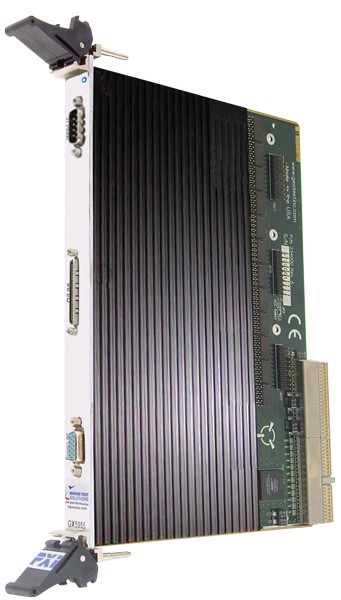
The following are key GX5055 characteristics and architecture features:
● The GX5055 is a Plug and Play (PnP) board. The operating system such as Windows will automatically identify and arbitrate resource requirements as well as notify the user that a new board was found and automatically install the driver for it.
● A DIO domain, when in RUN mode, operates independently of the host computer.
● Each GX5055 DIO board supports a maximum clock frequency of up to 50MHz per channel for all channels
● A GX5055 (Master) board controls the timing of a DIO domain and can be synchronized to a UUT.
● Multiple Master boards can be used to synchronize mutually asynchronous UUT elements.
● Each GX5055 Slave board adds 32 UUT channels. Up to 15 Slave boards can be added to make a 512-channel domain.
● Channel direction is controlled on a per channel. Direction can be set while in the RUN mode for each step, with input or output defined by the loaded vector.
● A DIO domain can be set to have an internal or external clock, in order to synchronize with the user UUT.
● A DIO domain clock source (internal or external), active when outputting data, can be programmatically delayed by DIO Domains on One PC Bus.
● A DIO domain Strobe source (internal or external), active when inputting data, can be programmatically delayed by 0-63.75 ns in increments of 0.25ns.
● The GX5055 firmware can be upgraded via the DIO driver.
● The GX5055 includes 5 banks of 512K by 32 memory, supporting drive, input, direction, control and data valid functionality for each channel.
● The GX5055 operates in any 6U PXI chassis that supports an air flow rate of 20 cfm/slot. Power for the pin electronics requires the use of external power supplies or the GX5055 can be used with a Marvin Test Solutions GX7005A PXI chassis which is designed for the GX5055 and includes the necessary pin electronics power supplies.
● The GX5055 functions as a state machine with three main states: HALT, PAUSE and RUN. One of the GX5055’s functional modules is the sequencer. The sequencer interprets commands stored in a memory array and controls the state machine. The sequencer controls the address of the memory arrays and thereby controls the flow of drive / sense data when the board is in the RUN state.
● External control signals include CLK, strobe and I/O pin direction. The combination of the external bi-directional control and external clocking, strobing, and triggering provides the capability to fully synchronize with UUTs, minimizing initialization procedures. The board sequencer permits the creation of conditional and unconditional loops and branches to manipulate the output vectors. This provides the capability to generate indefinite stimulus vectors at the maximum test rate.
● Each channel features a Parametric Measurement Unit (PMU). The PMU offers the ability to perform analog measurements on each digital pin. Measurement configurations include force voltage, measure current and force current, measure voltage.
● Each channel’s operating temperature, Vcc / Vee voltage rails, drive high / drive low voltages, sense hi / sense lo voltages, and output current values can be monitored and measured.
● Each input channel’s source and sink load currents can be set programmatically. The input channel’s constant current source will be active when the input voltage is above or below the voltage clamp values.
● • Each input channel’s constant current voltage clamps can be set programmatically. With independent high and low clamping (commutating) voltages, the source and sink currents each have their own threshold clamp voltages.
● Each input channel‘s load may be configured as a selectable resistor with programmable pull-up and pull-down values or the load can be programmed to be an open.
● Each output channel’s data can be can be formatted in five different ways, No Return: Return to Zero, Return to One, Return to Hi-Z, Return to Complement.
● Each output channel has independent adjustments for the rising and falling edge slew rates.
● Each output channel’s drive low and drive high level voltages can be set programmatically. Each output channel’s driver has two levels, low and high. The total output driver voltage swing (output driver high voltage less output driver low voltage) is limited to 25 per channel.
GX5055 Complete View