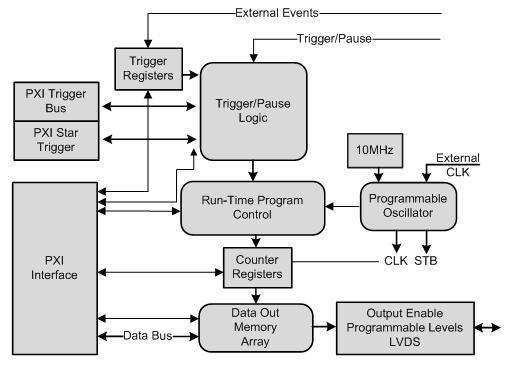
The GX5280 can run at frequencies as high as 200MHz (See specifications) feature three deep onboard memory options: 32, 64, or 128 Mbit/Channel. Each board contains 32 I/O pins arranged in 4 groups of 8, each group having its own direction either input or output applied to all steps in the group. The I/O stage can be software-configured to interface with a broad set of common logic families of 5,0 V, 3,3 V, 2,5 V and 1,8 V. as well as additional dedicated LVDS I/O stage connector. In addition the I/O voltage stage can be programmed with 10 mV resolution ranges from 1.4V to 3.6V. The programmed voltage level determines the logic high level for channels programmed to output mode and defines the threshold level for channels defined as input.
The GX5280 works as a complex programmable state machine with three main states: HALT, PAUSE and RUN. The central module of the board is the Vector Program Control. The Vector Program Control interprets predefined commands, controls the states machine and monitors the complex Trigger/Pause mechanism.
External control provides CLK, strobe and I/O pin direction from an external source. The combination of the external bi-directional control and external clocking, strobing, and triggering provides the capability to fully synchronize with UUTs and to minimize initialization procedures. The board sequencer permits the creation of conditional and unconditional loops and branches to manipulate the output vectors. This provides the capability to generate indefinite stimulus vectors at the maximum test rate.
Architecture Diagram