Architecture and Features
The following are key characteristics and features of the GX5295’s architecture:
● The GX5295 is
a Plug and Play (PnP) board. The
operating system (Windows 32/64-bit) automatically identifies and arbitrates
resource requirements, notifies the user that a new board has been found
and automatically installs the driver for it.
● A DIO domain
operates independently of the host computer when in RUN mode.
● Each GX5295
DIO board supports a maximum clock frequency of up to 100MHz per channel
for all channels.
● A GX5295 (Master)
board controls the timing of its domain and can be synchronized to a UUT.
● Any GX5295 board
can be configured programmatically to be a Master or Slave.
● Multiple Master
boards are used to synchronize mutually asynchronous UUT elements.
● • Each GX5295
Slave board adds 32 UUT channels. Up to 15 Slave boards can be added to
make a 512-channel domain.
● Each channel
can be enabled or disabled on a per vector basis. Disabled output channels
will be in a tri-state mode – facilitating the testing or emulation of
bi-directional busses.
● Each Master
has an external event bus. This bus is used for triggering and synchronizing
with external events.
● 4 auxiliary
channels are available for use as input/ output triggers of events. These
channels have programmable drive hi / drive lo and sense hi/ sense lo
levels – identical to the features associated with the 32 I/O channels.
Additionally, these channels have PMUs, providing additional parallel
PMU test capability beyond the 32 I/O channels.
● Multiple trigger
sources are available: Programmed PXI Trigger line, Star Trigger, External
Trigger, Internal trigger (software) or event driven trigger (generated
by external events). All trigger sources can work in tandem.
● An event driven
trigger can be generated by external events on the Timing Connector’s
External Event lines. Event and Mask registers are used to determine both
the triggering event and the bits to be ignored or masked. These
functions use the D Event and D Mask registers and the T Event and T Mask
registers.
● External triggering
can be initiated on sequential or concurrent events by using both D and
T event registers to define events.
● Multiple pause
sources are available: Programmed PXI Trigger line, External Pause, Internal
pause (software) or event driven pause (generated by external events).
All pause sources can work in tandem.
● The test sequence
(vector) can be paused on external events unconditionally or conditionally.
The P Event and P Mask registers define the condition and bits that generate
a conditional pause.
● An X Register
is used to emulate an External Event condition under program control for
purposes of test program verification. The register is loaded through
the computer bus.
● A DIO domain
can be setup to use an internal or external clock, in order to synchronize
with the user UUT.
● The DIO domain
clock source (internal or external), when active, can be programmatically
delayed by 0-27 nSec (increments of 0.25 nSec) relative to the output
data.
● DIO domain Strobe
source (internal or external) which clocks input data can be programmatically
delayed by 0-27 nSec (increments of 0.25 nSec) relative to input data.
● All GX5295 Firmware
can be upgraded through the DIO’s In-System- Programming (ISP) facility.
● Channel direction
can be programmed on a per pin and per step basis at test rates up to
100MHz.
● User programmable
PXI Star Trigger input supports Trigger and/or Pause functionality.
● The GX5295 sequencer
can halt or pause on a defined address, loop through the entire memory,
or loop on a defined address or defined block of memory.
● All on-board
memories are cleared (set low) whenever recycling power.
● • Each channel
has a full featured, pin electronics (PE) interface providing programmable
drive high, drive low, sense, sense low, and active source and sink current
load, and commutation voltage features. The drive / sense voltage range
is -2 to +7 volts with a maximum swing of 8 volts p-p.
● Each channel
also features a fully integrated Parametric Measurement Unit (PMU) for
measuring a component’s DC characteristics. Each PMU operates independently
and can be configured for force voltage / measure current or force current
/ measure voltage mode. 8 current force / measure ranges are supported,
ranging from 32 mA to 2 uA full scale. The PMU voltage range is -2.0V
to +7.0V volts. For high speed measurements, each PMU features programmable
high / low limit comparators, allowing for the implementation of fast
go / no-go PMU measurements.

|
Caution - Do not
connect a device under test (DUT) to the GX5295’s I/O connections
prior to powering up the card. Transient voltages can be present
on the card’s I/O connectors at power up which can damage the
DUT. Always disconnect the DUT prior to powering up the card. |
The figure below shows a complete view of the GX5295
board. The GX5295 features two interface connectors, one for the 32 digital
I/O channels and the other connector providing access to timing and event
signals as well the four auxiliary PE channels.
View of a GX5295 board
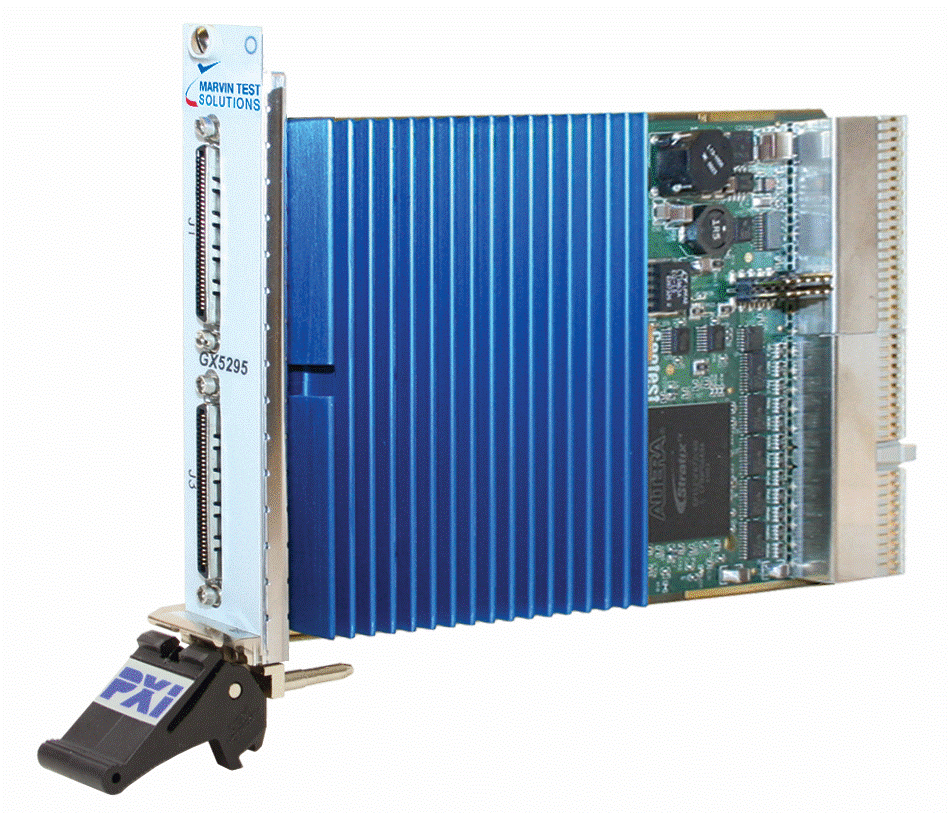
The GX5295 board
Models and Accessories
The following GX5295 accessories are available:
● GT95014
– Connector interface, SCSI to 100 Mil Grid, Single Ended I/F Board
● GT95015
– Connector interface, SCSI to 100 Mil Grid, Differential I/F Board
● GT95021
– 2’ shielded cable (68-pin SCSI)
● GT95022
– 3’ Shielded cable (68-pin SCSI)
● GT95028
– 10’ Shielded cable (68-pin SCSI)
● GT95031
- 6’ Shielded cable (68-pin SCSI)