Architecture
The GX5295 is a high performance, cost-effective 3U PXI dynamic digital
I/O board with 32 I/O channels and features dynamic direction control
with high performance pin electronics. The GX5295 offers 256M of on-board
memory and supports test rates up to 100 MHz. The single board design
supports both master and slave functionality without the use of add-on
modules Each card can function as a stand-alone digital subsystem or if
required, multiple cards can be interconnected, providing a single domain
and supporting up to 512 bi-directional pins. Each digital pin can be
individually programmed for a drive high / drive low voltage, input threshold
high / low voltage, and a source / sink current load value (with commutation
voltage level) – offering the user complete flexibility when creating
test programs and fixtures for multiple UUTs. The drive and sense voltage
levels can be programmed between -2 V and +7 volts with maximum span of
8 volts p-p. The GX5295 utilizes the PXI Local Bus to distribute signals
across a domain. Triggering to/from other modules utilize the PXI backplane
Trigger Bus to distribute signals across a domain (user defined).
Separate memories are provided for output data, response data (input)
and direction control. Each has 256 MB with 64 Mb per channel. The separate
response data memory supports the recording of activity on the UUT pins
independent of the bi-direction control.. Additionally, the GX5295 can
be configured to support real-time digital compare, eliminating the need
to capture and analyze acquired data.
The GX5295 provides programmable output clocks and strobes, and external
clock and strobe inputs as well a external event inputs. Four auxiliary
pin electronic channels are available for use with clock inputs / outputs
or external events. A programmable PLL (phase locked loop) provides configurable
clock frequencies for module clocking as well as a range of programmable
clock delays for the drive and strobe clock signal. The GX5295’s sequencer
can halt or pause on a defined address or loop through the entire memory
as well as loop on a defined address range or through a defined block
of memory.
The GX5295 works as a complex programmable state machine with three
main states: HALT, PAUSE and RUN. The central module of the board
is the Vector Program Control. The Vector Program Control interprets predefined
commands, controls the state machine and monitors the complex Trigger/Pause
mechanism.
Each channel has its own Parametric Measurement Unit (PMU). The PMU
offers the ability to perform analog measurements on each digital pin.
Measurement configurations include force voltage, measure current and
force current, measure voltage.
The figure below presents a block diagram of the GX5295’s digital architecture.

|
Caution - The GX5295 is high
performance instrument and must have sufficient cooling to ensure
long term, reliable operation. Operating the unit in a PXI chassis
with inadequate airflow or in an open chassis can cause overheating
and damage to the module. |

|
Caution - Do not
connect a device under test (DUT) to the GX5295’s I/O connections
prior to powering up the card. Transient voltages can be present
on the card’s I/O connectors at power up which can damage the
DUT. Always disconnect the DUT prior to powering up the card. |
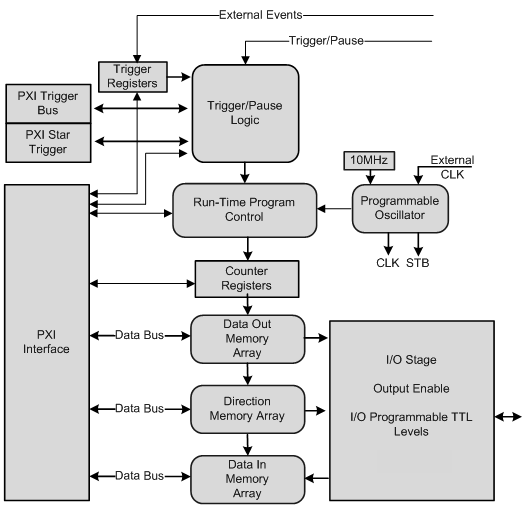
Architecture Diagram