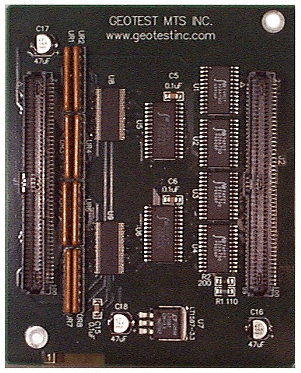
GT5960 is a Low Voltage Differential Signaling Transmitter/Receiver plug-in module for the GT5150 and GT5900. The GT5960 uses a differential low voltage swings in order to achieve high data transmission speeds at lower power consumption. The receivers, which respond only to differential voltages, eliminate noise such as common-mode signal reflections as well as emitting less electromagnetic interference (EMI) than other data transmission standards.
GT5960 Low Voltage Differential Signaling
The GT5960 employs a pair of SN75LVDS386 and a pair of SN75LVDS387 to provide up to 32 bi-directional channels. The module supports configurations of 8, 16, and 32 bi-directional channels. On-board register/MUX logic controls the path of data in both input and output modes of operation and determines the output state after a sequencer HALT. SIP sockets provide installation of terminators; 100 ohms resistor networks are factory installed (termination is required on the receivers to limit reflections).
The ultimate rate and distance of LVDS data transfer is dependent on the attenuation characteristics of the media and the noise coupling to the environment.
The GT5960 Module is controlled by its host, the GT515X or GT25/50 (using GT5900) and provides the following programmable functions:
● Set the width, number of active channels, as 32, 16, or 8 channels.
● Global Output Reset
● Tri-state Output on sequencer HALT
● Hold Last Value output on sequencer HALT
● Termination Enable/Disable
● Enable/disable all 8 outputs in a group, four groups in total, in each vector step.
A block diagram of the GT5960 is displayed in the figure below:
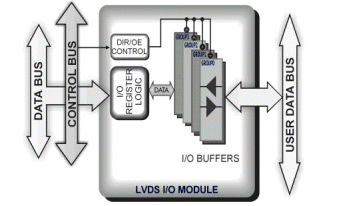
GT5960 Block Diagram
The GT5960 bi-directional I/O Module interfaces DIO boards to external equipment and UUTs that uses the LVDS standard. Using the LVDS standard insure unparalleled signal integrity while maintaining high frequency in any environment.
Width setting - Set the number of active channels, as 32, 16, or 8 channels causing the memory depth to increase/decrease by the same factor. E.g. setting the width to 16 will decrease the number of active channels by two and increase the available number of memory step by two.
Tri State – High impedance outputs can be enabled or disabled in groups of eight during vector execution. The high impedance output state supports the connection of DIO boards to a UUT bus up to 32 bits wide.
Retain Last Value – The output mode can be configured to either retain the last value on vector halt, or switch to high impedance.
Line Terminations – Terminators can be switched in or out under program control. 180/330 or 330/390 SIPs are standard. SIPs mount in sockets to accept other (user-supplied) termination values.
The table below describes a GT515x (J4) / GT5900 (J10 and J11) interface to UUT data signals when a GT5960 Module is mounted on the motherboard.
Pin |
Signal |
Type |
Pin |
Signal |
Type |
Pin |
Signal |
Type |
1 |
I/O0+ |
I/O |
24 |
I/O23+ |
I/O |
47 |
I/O12- |
P |
2 |
I/O1+ |
I/O |
25 |
I/O24+ |
I/O |
48 |
I/O13- |
P |
3 |
I/O2+ |
I/O |
26 |
I/O25+ |
I/O |
49 |
I/O14- |
P |
4 |
I/O3+ |
I/O |
27 |
I/O26+ |
I/O |
50 |
I/O15- |
P |
5 |
I/O4+ |
I/O |
28 |
I/O27+ |
I/O |
51 |
I/O16- |
P |
6 |
I/O5+ |
I/O |
29 |
I/O28+ |
I/O |
52 |
I/O17- |
P |
7 |
I/O6+ |
I/O |
30 |
I/O29+ |
I/O |
53 |
I/O18- |
P |
8 |
I/O7+ |
I/O |
31 |
I/O30+ |
I/O |
54 |
I/O19- |
P |
9 |
I/O8+ |
I/O |
32 |
I/O31+ |
I/O |
55 |
I/O20- |
P |
10 |
I/O9+ |
I/O |
33 |
+5V |
P |
56 |
I/O21- |
P |
11 |
I/O10+ |
I/O |
34 |
GND |
P |
57 |
I/O22- |
P |
12 |
I/O11+ |
I/O |
35 |
I/O0- |
P |
58 |
I/O23- |
P |
13 |
I/O12+ |
I/O |
36 |
I/O1- |
P |
59 |
I/O24- |
P |
14 |
I/O13+ |
I/O |
37 |
I/O2- |
P |
60 |
I/O35- |
P |
15 |
I/O14+ |
I/O |
38 |
I/O3- |
P |
61 |
I/O26- |
P |
16 |
I/O15+ |
I/O |
39 |
I/O4- |
P |
62 |
I/O27- |
P |
17 |
I/O16+ |
I/O |
40 |
I/O5- |
P |
63 |
I/O28- |
P |
18 |
I/O17+ |
I/O |
41 |
I/O6- |
P |
64 |
I/O29- |
P |
19 |
I/O18+ |
I/O |
42 |
I/O7- |
P |
65 |
I/O30- |
P |
20 |
I/O19+ |
I/O |
43 |
I/O8- |
P |
66 |
I/O31- |
P |
21 |
I/O20+ |
I/O |
44 |
I/O9- |
P |
67 |
+5V |
P |
22 |
I/O21+ |
I/O |
45 |
I/O10- |
P |
68 |
GND |
P |
23 |
I/O22+ |
I/O |
46 |
I/O11- |
P |
Types: I/O = Input/Output, P = Power or Ground
UUT-Side I/O Connections with a GT5960 Mounted
UUT-Side I/O Connections with a GT5960 Mounted describes GT515X signals at J4 and Carrier signals at J11. It also describes Carrier signals at J10 when the Carrier input is connected for I/O data.
Min |
Type |
Max |
|
I/O Channels Per Module |
GT5960: Configurable: 32, 16, or 8 bit |
||
Terminations |
|
||
Type |
|
||
Output Level |
|||
Diff. Magnitude |
|
|
|
Between States |
|
|
|
Input Level |
|||
Positive-Going Diff. Threshold |
|
|
|
Negative-Going Diff. Threshold |
|
|
|
High |
|
|
|
Low |
|
|
|
Dynamic Transition Current |
|
|
|
Power |
|
|
|
Propagation |
|||
Delay Output |
|
|
|
Delay Input |
|
|
|
Output Skew |
|
|
|
Temperature Range |
|||
Operating |
|
0°C to +50°C |
|
Storage |
|
-20 to +70°C |
|
Size |
4.40" x 3.40" |
||
Weight |
|
|
|