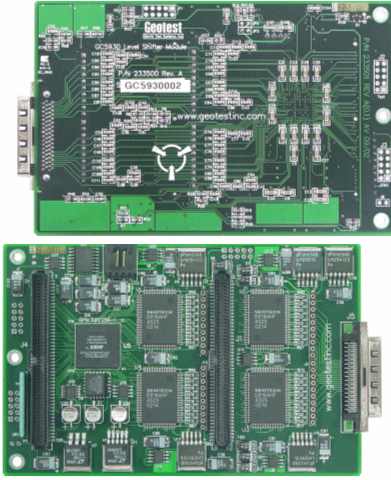
The GC5930 programmable level I/O module eliminates the need to create custom interface circuits. The GC5930 module interfaces between a GC5050 TTL environment and the variable custom levels at the UUT. The GC5930 is mounted on the GC5050 and provides 32 channels of programmable level translation outputs combined with programmable level threshold inputs.
A picture of the GC5930 is displayed in the figure below:
GC5930 Programmable Level I/O Module
The GC5930 employs the EDGE818 octal pin driver/receiver to provide programmable Output/Inputs and threshold levels. The module has two independent group of channels, Group A composed of channels 0-15 and Group B composed of channels 16-31. Each group has its own logic and can be set to different high voltage and different threshold voltage, which are common to all I/O channels in the group (the low voltage is set to zero). The driver output and receiver input range allows a direct interface to TTL, CMOS (3V, 5V, and 8V), and custom level circuitry.
Programming of the GC5930 Module is performed via the host, programmable functions include:
● Programmable High I/O voltage levels per group.
● Programmable Threshold voltage levels per group with common threshold level for all channels in the group.
● Tri-state control (enable/disable all output channels).
● Controlling the Output enable of each of the four available groups (via the loaded vector).
A block diagram of the GC5930 is displayed in the figure below.
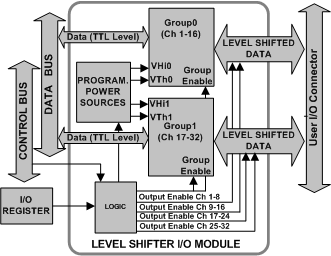
GC5930 Block Diagram
The GC5930 provides a programmable logic level interface. It translates up to 32 channels of GC5050 DIO board TTL levels to/from external equipment and UUT logic levels in two independent groups of 16 channels each.
Level shifting is achieved using special driver/receiver pairs and on-board programmable variable power supplies to translate logic levels. Interfaces to TTL, CMOS as well as custom levels can be translated within the module operating voltage range (see Specification table).
Programmable logic thresholds determine voltages at which logic levels from UUT inputs are distinguished. Three voltage sources: +5v, +12V and –12V are used by the module. The +/-12V voltage source can be set using on-board jumpers, to either use the internal voltages or use external power supply connected via on-board connector for greater noise rejection. The default setting is for internal power.
Direction Control - Static I/O direction switching, configured when set up for GC5050 boards to either Output or Input.
Tri State – High impedance outputs can be enabled or disabled in groups of eight during vector execution. The high impedance output state supports the connection of DIO boards to a UUT bus up to 32 bits wide.
Retain Last Value – The output mode can be configured to either retain the last value on vector halt, or switch to high impedance.
Signal termination is done using SIPs resistors mounted on four sockets (one per 8 channels). Since different application required different resistance the user need to fit the SIPs resistors values to the application. The following diagram shows a single GC5930 I/O channel:
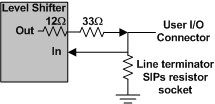
Single GC5930 I/O channel
Note: Board direction enable/disable the Level Shifter Out/In lines.
When outputting vectors there is a 33Ohm in-line resistor that protects each GC5930 output channel in case of a short to ground and also serves as a series terminator. The driver has an internal 12Ohm in-line resistor.
The table below describes GC5050 to UUT data signals with a GC5930 (Programmable Level) I/O Module mounted on the motherboard.
Pin |
Signal |
Type |
Pin |
Signal |
Type |
Pin |
Signal |
Type |
Pin |
Signal |
Type |
1 |
IO0 |
I/O |
18 |
IO17 |
I/O |
35 |
GND |
I/O |
52 |
GND |
P |
2 |
IO1 |
I/O |
19 |
IO18 |
I/O |
36 |
GND |
I/O |
43 |
GND |
P |
3 |
IO2 |
I/O |
20 |
IO19 |
I/O |
37 |
GND |
I/O |
54 |
GND |
P |
4 |
IO3 |
I/O |
21 |
IO20 |
I/O |
38 |
GND |
I/O |
55 |
GND |
P |
5 |
IO4 |
I/O |
22 |
IO21 |
I/O |
39 |
GND |
I/O |
56 |
GND |
P |
6 |
IO5 |
I/O |
23 |
IO22 |
I/O |
40 |
GND |
I/O |
57 |
GND |
P |
7 |
IO6 |
I/O |
24 |
IO23 |
I/O |
41 |
GND |
I/O |
58 |
GND |
P |
8 |
IO7 |
I/O |
25 |
IO24 |
I/O |
42 |
GND |
I/O |
59 |
GND |
P |
9 |
IO8 |
I/O |
26 |
IO25 |
I/O |
43 |
GND |
I/O |
60 |
GND |
P |
10 |
IO9 |
I/O |
27 |
IO26 |
I/O |
44 |
GND |
I/O |
61 |
GND |
P |
11 |
IO10 |
I/O |
28 |
IO27 |
I/O |
45 |
GND |
I/O |
62 |
GND |
P |
12 |
IO11 |
I/O |
29 |
IO28 |
I/O |
46 |
GND |
I/O |
63 |
GND |
P |
13 |
IO12 |
I/O |
30 |
IO29 |
I/O |
47 |
GND |
I/O |
64 |
GND |
P |
14 |
IO13 |
I/O |
31 |
IO30 |
I/O |
48 |
GND |
I/O |
65 |
GND |
P |
15 |
IO14 |
I/O |
32 |
IO31 |
I/O |
49 |
GND |
I/O |
66 |
GND- |
P |
16 |
IO15 |
I/O |
33 |
N/C |
P |
50 |
GND |
I/O |
67 |
N/C |
P |
17 |
IO16 |
I/O |
34 |
GND |
P |
51 |
GND |
I/O |
68 |
GND |
P |
UUT-Side I/O Connections with a GC5930 Mounted, J5
Notes:
● Pin: Pin number
● I/O: Input or Output
● P: Power/GND
● I/O0 – I/O31: Data Lines. Non-differential I/O Modules.
● N/C – Not connected.
|
Min |
Type |
Max |
Level Translator Module |
|||
I/O Channels Per Module |
32 bi-directional (Software Programmable Direction) |
||
Per channel Driver/Receiver Characteristics |
|||
Type |
EDGE818 |
||
Programmable voltage range (all channels) |
0 to + 9 |
||
DC Driver Output Current (single channel) |
|
|
75mA |
DC Driver Output Current (total per group of eight) |
|
|
200 mA |
Output Impedance |
9W |
12W |
15W |
Pin Capacitance |
|
20pF |
|
Receiver Threshold Voltage |
0V |
|
+9V |
Per channel Driver/Receiver Characteristics (revision D and above) |
|||
Type |
|
|
EDGE818 |
Programmable voltage range (all channels) |
0 to + 9 |
||
DC Driver Output Current |
-100mA |
|
+100mA |
Output Impedance |
|
15W |
|
Pin Capacitance |
|
20pF |
|
Receiver Threshold Voltage |
0V |
|
+9 V |
Power |
|||
3.3VDC |
|
|
0.4A |
5VDC |
|
|
0.1A |
+12VDC |
|
|
1.8A |
-12VDC |
|
|
-0.5A |
Max Operating Frequency |
50MHz |
||
Size |
4.40 x 3.40 Inch |
||
Weight |
70g |
||
Temperature Range |
|||
Operating |
0°C |
|
+50°C |
Storage |
-20°C |
|
+70°C |