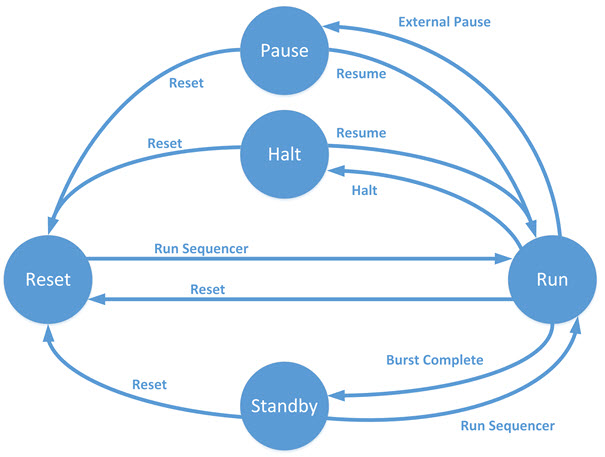
The GX5296 board has five operational states: Reset, Standby, Halt, Pause and Run.
The figure is a block diagram showing the relationship of these operational states.
GX5296 Operational States
When the sequencer is first powered on, or goes through a Reset or Sequencer Reset, it is in the Reset State. In this state the sequencer is not active and all outputs are tri-stated. All real-time compare errors are cleared and the sequencer is ready to enter another state.
The Standby State is entered when a Run ends (burst complete) or the sequence is stopped manually by the user. When in the Standby State, the sequencer will continue to execute the first vector of the last step in a burst. This Standby State allows the user to maintain the UUT in inactive state between Digital Bursts. The Standby State can exit by a Reset or Run command.
The Run State is the primary execution state. The Run State can be entered manually, by user command or through an external trigger. The sequencer will run through each Step and execute each Vector assigned to the respective Step. The Vector Memory is busy during this state and it cannot be accessed by the User.
The Halt State is entered through manual intervention by the user. The different Software Halt modes can be set by the user to allow different behaviors to occur when a Software Halt is commanded by the user. During the Halt state, the last Vector is output statically on the I/O channels.
The Pause State is entered through external triggering or Pause signals and provides handshaking capability with external events or triggers. The Pause State is similar to the Halt State and is controlled by the current Pause Mode.
The following table describes the six execute states of the GX5296 and how the state is entered:
Setting |
Description |
Entry Condition |
RESET |
Sequence Active: falseHalt flag: falsePaused flag: falseActive step: 0Pattern Memory: Accessible |
Power OnReset (GtDio6xReset API). |
STANDBY |
Sequence Active: falseHalt flag: falsePaused flag: falseActive step: UserPattern Memory: Accessible |
Stop (GtDio6xSequencerStop API). |
RUN |
Sequence Active: trueHalt flag: truePaused flag: falseActive step: UserPattern Memory: Busy |
Run (GtDio6xSequencerRun API).Resume (GtDio6xSequencerResume API). |
HALT |
Sequence Active: trueHalt flag: truePaused flag: falseActive step: UserPattern Memory: Accessible |
Halt (GtDio6xSequencerHalt API). |
PAUSE |
Sequence Active: trueHalt flag: falsePaused flag: trueActive step: UserPattern Memory: Busy |
Pause (GtDio6xStepSetPauseResumeTrigger API). |
Sequencer Operation Notes:
1. The GX5296 sequencer must start a digital burst on step 0.
2. Starting from a non-zero step requires a jump command at step 0 to the non-zero step.