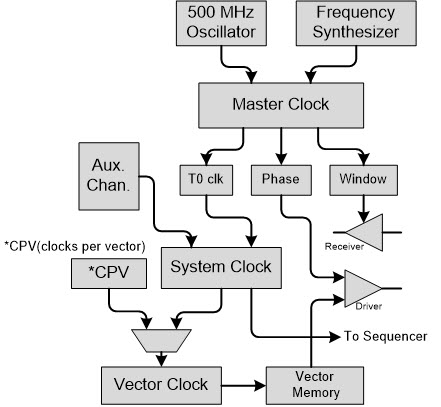
The GX5960 system uses several clocking signals to generate and capture digital vectors from the I/O Channels.
Clock Architecture Overview
The master clock defines the edge or timing resolution. This block contains a fixed 500 MHz master clock oscillator and a Frequency Synthesizer (FS) which may be used in lieu of the 500 MHz oscillator. The reference clock for the Frequency Synthesizer may be the built-in 20 MHz oscillator, 10 MHz PXI clock or an external oscillator in the range of 5 to 80 MHz.
Source |
Description |
500 MHz |
Sequencer (timing) resolution set to 2ns. |
Frequency Synthesizer |
Sequencer resolution set to 1 / (2 * FS)For example, if FS = 100 MHzResolution = 1 / (2 * 100,000,000)Resolution = 5ns. |
Master Clock Source Settings
See GtDio6xSequencerSetMasterClockSource in the Function Reference section for information.
The System Clock is used to apply Step settings (such as Phase, Window, and T0 Clock) to the sequencer. The System Clock also generates the Vector Clock which is used to define a Vector’s period.
Source |
Description |
Internal T0 Clock |
System Clock driven by the internal T0 Clock which is programmed per Step. |
AUX0-AUX11 |
System Clock driven by the external auxiliary channels. |
Frequency Synthesizer |
System Clock driven by the internal frequency synthesizer signal. |
System Clock Source Settings
The relevant API function is: GtDio6xSequencerSetSystemClockSource.
The Vector Clock is derived from the System Clock and the Clocks per Vector setting. The Vector Clock period will equal the System Clock Period divided by the Clocks per Vector setting. The Vector Clock is used to clock out Vectors from memory when the Sequencer is running.
See GtDio6xStepSetClock in the functions reference chapter for information.