The following mathematical functions are available for use when constructing
the segment formula. Many
of these examples are included in the WaveEasy folder (.WaveEasy files).
Function |
Description |
Example |
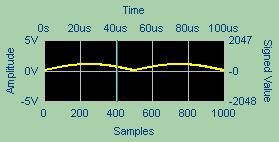
Abs(x) |
Absolute value of x. |
Abs(Sin(x))
|
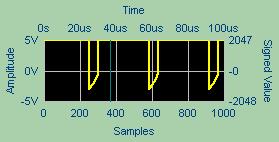
ArcCos(phase + cycles
* x) |
Inverse cosine of x. |
-2*ArcCos(x*3+90)
|
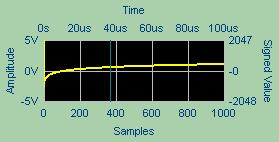
ArcCosh(phase + cycles
* x) |
Inverse hyperbolic cosine of x. |
-3 + 0.5 * ArcCosh(4
* x)
|
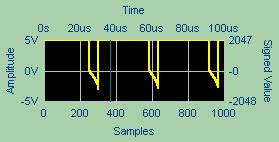
ArcSin(phase + cycles
* x) |
Inverse sine of x. |
-2*ArcSin(x*3+90)
|
ArcSinh(phase + cycles
* x) |
Inverse hyperbolic sine of x. |
-3 + 0.5 * ArcSinh(4
* x)
|
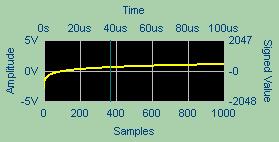
ArcTan(phase + cycles
* x) |
Inverse tangent of x. |
-3 + 2* ArcTan(4
* x)
|
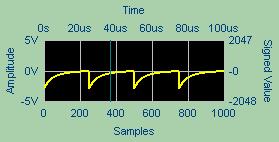
Ceil(x) |
Rounds the elements of x to the nearest
integers greater than or equal to x. |
Ceil(3*sin(4*x))
|
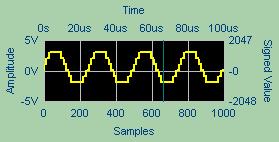
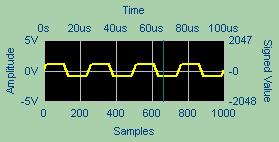
Clip(x, amplitude low, amplitude
high) |
Clip the
elements of x to the high/low amplitude. |
Clip(3*sin(4*x),
-1, 1)
|
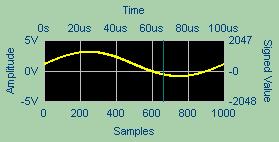
Container(x) |
Used in a formula for
a segment that has sub-segments. Represents a collection
of segment sub segments. |
1+2*Container(x)
and sub segment is Sin(x)
|
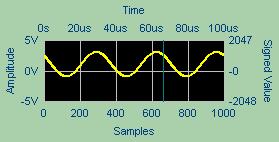
Cos(phase + cycles * x) |
Cosine of x. |
1+2*Cos(x*3+45)
|
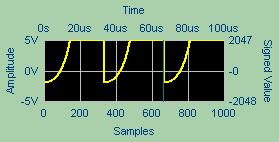
Cosh(phase + cycles
* x) |
Hyperbolic cosine of x. |
Cosh(x*3)-3
|
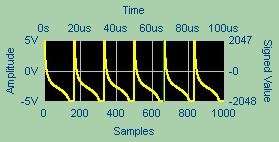
Cot(phase + cycles
* x) |
Cotangent of x. |
Cot(x*3)-3
|
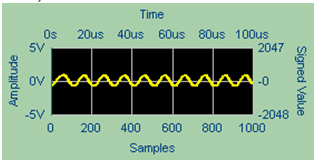
FFTBandPass
(x, filter order, cutoff low
freq, cutoff high freq) |
Filter that passes frequencies within a
certain range and rejects (attenuates) frequencies outside that
range. BandPass uses a frequency domain convolution. Highr
filter order produce better result however slower. |
FFTBandPass(Sin(10 * x) + 0.8 * Sin(50 *
x) + 0.5 * Sin(100 * x) + 0.2 * Sin(200 * x), 5, 0.001, 0.005)*4
|
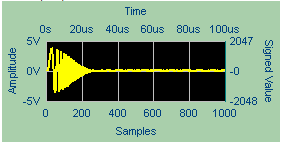
FIRBandPass
(x, filter order, cutof flow
freq, cutoff high freq) |
A filter that passes low frequencies well,
but attenuates (reduces the amplitude of) frequencies higher than
the cutoff frequency. LowPass uses a time domain convolution.
Highr filter order produce better result however slower. |
FIRBandPass(Sin(x^2), 1, 0.001, 0.1), see
Sin(x) to see Sin(x^2)
|
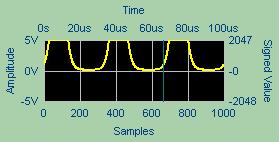
Exp(x) |
Exponent of x. |
Exp(3*Sin(3*x))
|
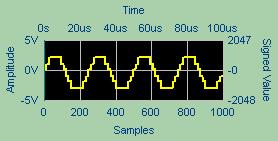
Floor(x) |
Rounds the elements of x to the nearest
integers smaller than or equal to x. |
Floor(3*Sin(4*x))
|
Ln(x) |
Natural logarithm of x. |
Ln(x)*0.3
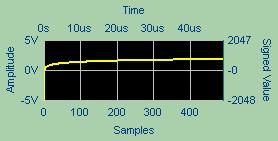
|
Log(x, base) |
The logarithm of x to the base. |
Log(x,
2)*Sin(4*x)
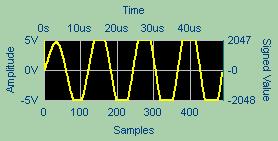
|
Log10(x) |
Common logarithm (base 10) of x. |
Log10(sin(2*
x))
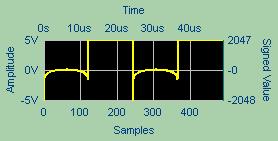
|
Noise(x) |
Noise generate
a number in the range -1 to 1. |
Sin(4*x)+0.5*Noise(x)
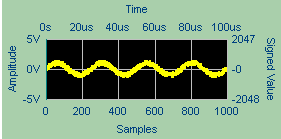
|
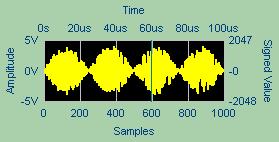
Rnd(x) |
Randomize number between 0 and 1. |
Sin(2*x)*Rnd(x)*4
|
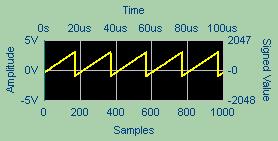
SawTooth(phase + offset
* x) |
Wave that resembles the teeth of a saw. |
1 + 2 * SawTooth(45
+ 5 * x)
|
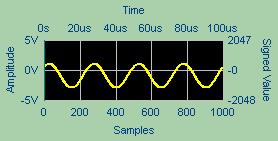
Sin(phase + cycles
* x) |
Sine of x. |
-1+2*Sin(4*x+45)
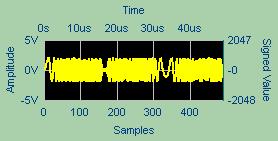
Sin(x^2)*2
|
Sinc(phase + cycles
* x, zero crossing) |
Sine cardinal of x. |
-1 + 4 * Sinc(45
+ 2 * x, 6) 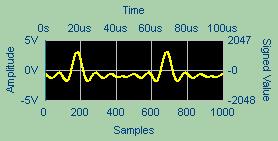 |
Sinh(phase + cycles
* x) |
Hyperbolic sine of x. |
-4 + 10 * Sinh(45
+ 3 * x)
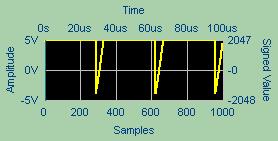
|
Sketch(x) |
Free Hand or line drawing using WaveEasy tools. Use
a formula to
manipulate and change the ammplitude, add offset, etc. |
Sketch(x)*2-1
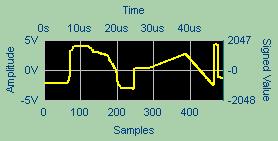
|
Square( phase + cycles *
x , duty cycle) |
Square of x. |
3.6 * Square(5
* x, 50)
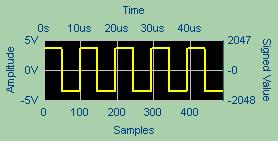
|
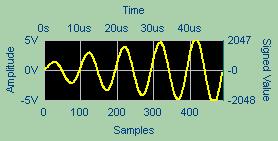
Sqrt(x) |
Square root
of x. |
Sqrt(x)
* 0.3 * sin(5 * x)
|
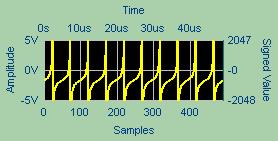
Tan(phase + cycles
* x) |
Tangent of x. |
-1.8 + 0.6 * Tan(5
* x)
|
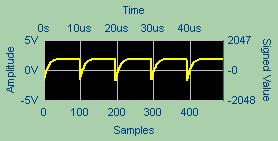
Tanh(phase + cycles
* x) |
Hyperbolic tangent of of x. |
-1.8 + 3.6 * Tanh(5
* x)
|
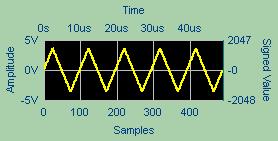
Triangle(phase + cycles
*) |
Triangle of
x. |
3.6 * Triangle(5
* x)
|