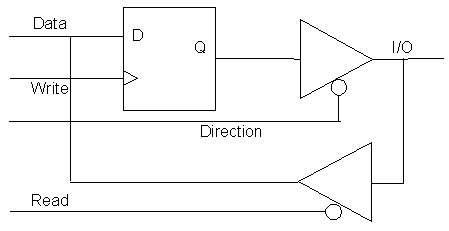
The GX5731 provides 128 digital Inputs or Outputs and 4 counters. The 128 TTL channels’ direction is programmable and can be set for Input or Output in groups of eight. The GX5731 has no on-board memory and it uses software driver to set or get the channels level and direction. The figure below shows a typical I/O channel block diagram:
Typical I/O Channel
The GX5731 consist of four 32-bit parallel input/output ports. Each port interfaces through a 68 pins SCSI connector (J10 to J13).
The GX5731 can have up to three Modules installed. Each installed module has an independent set of strobe signals controlled by software and hardware. The module strobe source can be set using software to one of the following sources:
Internal Clock0
Internal Clock1
User Line 0 to 5 (J6 pins 17-22)
External Strobe Input (pin 67)
When selecting the External Strobe Input the user can control the External Strobe Polarity and External Strobe Enable Polarity for negative or positive edge.
The figure below is a block diagram for the GX5731 Module’s Strobe Signals:
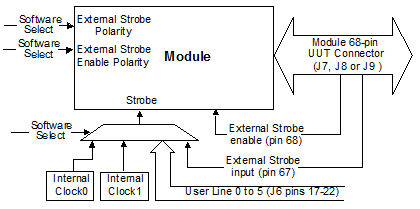
Module Strobe Signals
The GX5731 contains two internal clock sources that can be used to drive any of the installed modules. Each of the internal clocks can be configured to use the 10MHz PXI clock, 33 MHz PCI Bus clock or any of External Input User Lines 2-5 (J6 pins 19-22).
The figure below is a block diagram for the GX5731 Internal Clock Source:
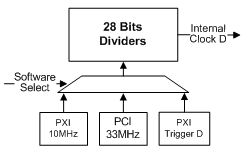
GX5731 Internal Clock Source
The GX5731 can have up to three Modules installed. Each installed module can use Direct Output/Input or Strobed Output/Input with handshaking.
When using Direct Output/Input on each strobe signal transition, the user is responsible for setting polarity via Gx5731ModuleSetExtStrobeEnablePolarity.
When using Strobed Output/Input with handshaking the hardware controls the Output/Input sequences. The handshaking mechanism is implemented using input and output control and strobe signals.
The GX5701 Digital Input Latch (DIL) Module has 32 input channels with 4K of high-speed buffer. The channels have programmable threshold of –30 to +30 volts with resolution of less than 1mV. The GX5701 can be triggered using internal or external strobe (software controlled). When using external strobe, the module supports Strobed Input with Handshaking.
Features:
Programmable threshold from –30 to +30 VDC.
Direct input or Strobed Input with Handshaking
Input trigger source may be internal, external or controlled by the user (step mode).
High-speed buffer 4K deep.
The figure below demonstrates the Handshaking process. Each signal number (1 to 9) is explained in table. The description of each timing segment (numbered 1-9) explained in the table below.
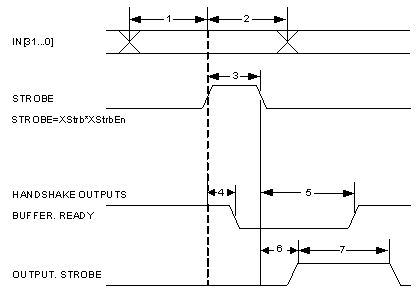
GX5701: Strobed Input with Handshaking timing diagram
The following table describes each timing segment (numbered 1-9):
Signal # |
Description |
Time (uSec) |
||
Min |
Type |
Max |
||
1 |
Data stable before strobe input is TRUE. |
250 |
||
2 |
Data stable after Strobe input is TRUE. |
20 |
||
3 |
Strobe input pulse width |
20 |
||
4 |
Buffer Ready FALSE after Strobe TRUE (set to TRUE when issue a software RUN command). |
15 |
||
5 |
Buffer ready TRUE after Strobe input is FALSE. |
100 |
150 |
|
6 |
Strobe output delay after Strobe input is FALSE. |
100 |
150 |
|
7 |
Strobe input pulse low Output strobe width (programmable with 50nS resolution). |
50 |
750 |
|
GX5701 - Strobed Input with Handshaking timing diagram symbol description
_Module.jpg "GX5701 - Digital Input Latch (DOL) Module")
GX5701 - Digital Input Latch (DOL) Module
The GX5702 Module Digital Output Latch (DOL) drives 32 output-latched channels with 4K of high-speed buffer.. Data can be latched to the output connector using
The GX5701 can be triggered using internal or external strobe (software controlled). When using external strobe, the module supports Strobed Input with Handshaking
Features:
32-channels of TTL or CMOS compatible outputs.
Direct input or Strobed Input with Handshaking
Output trigger source may be internal, external or controlled by the user (step mode).
Programmable strobe delay.
External Strobe input enable/disable by software.
Up to 4096 (4K) can be stored in a High-speed output buffer.
The figure below demonstrates the Handshaking process. The description of each timing segment (numbered 1-9) explained in the table below.
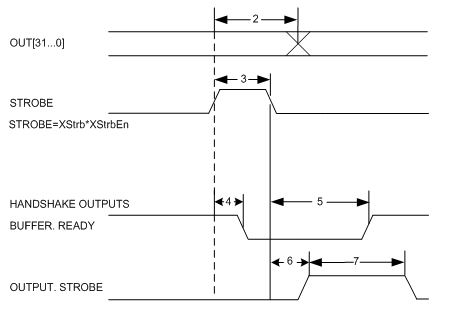
GX5702 - Strobed Output with Handshaking timing diagram
The following table describes each timing segment (numbered 1-9):
Signal # |
Description |
Time (uSec) |
||
Min |
Type |
Max |
||
2 |
Delay from Strobe input is TRUE to output valid. |
25 |
||
3 |
Strobe input Pulse Width. |
20 |
||
4 |
Buffer ready FALSE after Strobe TRUE (set to TRUE when issue a software RUN command). |
15 |
||
5 |
Buffer ready TRUE after strobe input is FALSE. |
100 |
150 |
|
6 |
Strobe output delay after Strobe input is FALSE. |
100 |
150 |
|
7 |
Strobe input pulse low Output strobe width (programmable with 50nS resolution) |
50 |
750 |
|
GX5702 - Strobed Output with Handshaking timing diagram symbol description
_Module.jpg "GX5702 - Digital Output Latch (DOL) Module")
GX5702 - Digital Output Latch (DOL) Module
The GX5704 Digital Power Output (DPO) Module has 32 output channels with 4K of high-speed buffer.
The GX5701 can be triggered using internal or external strobe (software controlled). When using external strobe, the module supports Strobed Input with Handshaking
Features:
32 open collector channels outputs.
Direct input or Strobed Input with Handshaking
Output trigger source may be internal, external or controlled by the user (step mode).
Programmable strobe delay.
External Strobe input enable/disable by software.
Up to 4096 (4K) can be stored in a High-speed output buffer.
The figure below demonstrates the Handshaking process. The description of each timing segment (numbered 1-9) explained in the table below.
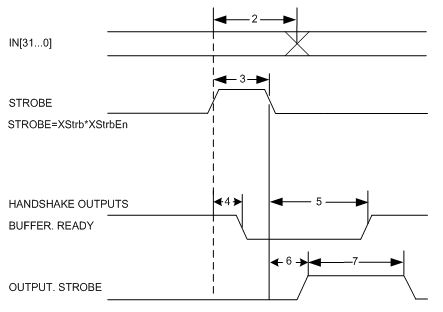
GX5704 - Strobed Output with Handshaking timing diagram
The following table describes each timing segment (numbered 1-10):
Signal # |
Description |
Time (uSec) |
||
Min |
Type |
Max |
||
2 |
Delay from Strobe input is TRUE to output valid. |
5000 |
||
3 |
Strobe input Pulse Width. |
20 |
||
4 |
Buffer ready FALSE after Strobe TRUE (set to TRUE when issue a software RUN command). |
15 |
||
5 |
Buffer ready TRUE after Strobe input is FALSE. |
100 |
150 |
|
6 |
Strobe output delay after Strobe input is FALSE. |
100 |
150 |
|
7 |
Strobe input pulse low Output strobe width (programmable with 50nS resolution) |
50 |
750 |
|
GX5704 - Strobed Output with Handshaking timing diagram symbol description
_Module.jpg "GX5704 - Digital Power Output (DPO) Module")
GX5704 - Digital Power Output (DPO) Module
The GX5709 RS422 Port I/O Module is a differential RS422 32 I/O channels module. The direction and of each group of eight channels can be programmed as Input or Output. The of each. The termination of each group of eight channels can be programmed to be On or Off.
Features:
32 differential RS422 I/O channels Module.
Programmable direction of channels in groups of eight.
Programmable termination of channels in groups of eight.
The RS422 I/O channels’ direction is programmable and can be set for Input or Output in groups of eight. The GX5709 Module uses software driver to set or get the channels logic level and direction. the figure below shows a typical I/O channel block diagram:
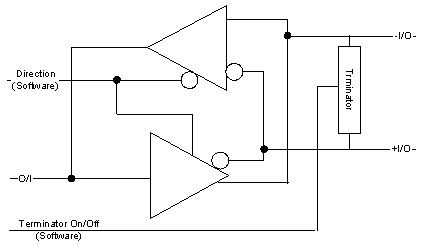
Typical RS422 I/O Channel Block Diagram
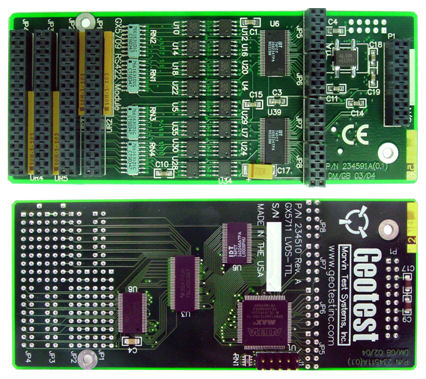
GX5709 - RS422 Port I/O Module
The GX5711 Bidirectional LVDS-TTL Converter Module is a 16 channels module converting signals from LVSD to TTL or vise versa. The direction of each group of eight channels can be programmed as LVDS to TTL or TTL to LVDS. Each group conversion direction source can be either internal (software) or external. All 16 differential channels can have termination can be programmed to be On or Off.
Features:
16 Bidirectional LVDS-TTL channels Module.
Programmable direction of channels in groups of eight.
Programmable conversion direction source as either internal (software) or external.
Direction Programmable direction of channels in groups of eight.
Programmable termination of channels.
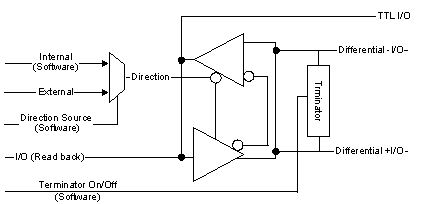
GX5711 - Typical Bidirectional LVDS-TTL channel Block Diagram
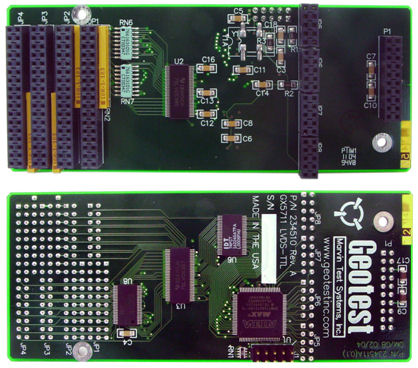
GX5711 - Bidirectional LVDS-TTL Converter Module
The GX5712 Bidirectional RS422-TTL Converter Module is a 16 channels module converting signals from RS422 to TTL or vise versa. The direction of each group of eight channels can be programmed as RS422 to TTL or TTL to RS422. Each group conversion direction source can be either internal (software) or external. All 16 differential channels can have termination can be programmed to be On or Off.
Features:
16 Bidirectional RS422-TTL channels Module.
Programmable direction of channels in groups of eight.
Programmable conversion direction source as either internal (software) or external.
Direction Programmable direction of channels in groups of eight.
Programmable termination of channels.
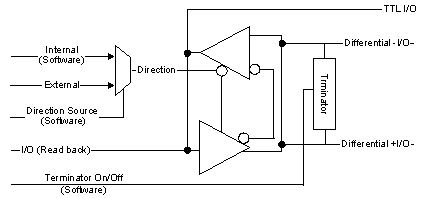
GX5712 - Typical Bidirectional RS422-TTL channel Block Diagram
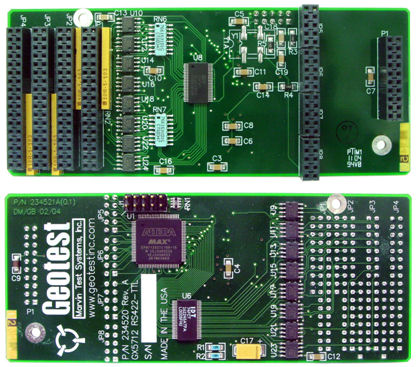
GX5712 - Bidirectional RS422-TTL Converter Module