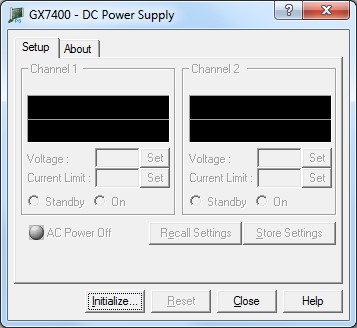
The GXPS includes a virtual panel program, which provides full access to the various configuration settings and operating modes. To understand the front panel operation, it is best to become familiar with the functionality of the board.
To open the virtual panel application, select GX7400 Panel from the Marvin Test Solutions, GXPS menu under the Windows Start menu. The GX7400 virtual panel opens as shown here:
GX7400 Virtual Panel
The function of the panel button controls are shown below:
Initialize - opens the Initialize Dialog (see Initialize Dialog paragraph) in order to initialize the board driver. The current settings of the selected counter will not change after calling initialize. The panel will reflect the current settings of the counter after the Initialize dialog closes.
Reset - resets the PXI board settings to their default state and clears the reading.
Apply – applies changed settings to the board
Close - closes the panel. Closing the panel does not affect the board settings.
Help - opens the on-line help window. In addition to the help menu, the caption shows a What’s This Help button (?) button. This button can be used to obtain help on any control that is displayed in the panel window. To display the What’s This Help information click on the (?) button and then click on the control – a small window will display the information regarding this control.
The Initialize dialog initializes the driver for the selected counter board. The counter settings will not change after initialize is called. Once initialize, the panel will reflect the current settings of the counter.
The Initialize dialog supports two different device drivers that can be used to access and control the board:
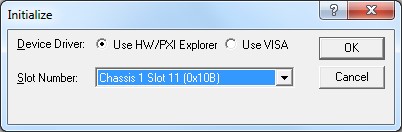
Initialize Dialog Box using Marvin Test Solutions' HW driver
Use Marvin Test Solutions' HW – this is the device driver installed by the setup program and is the default driver. When selected, the Slot Number list displays the available counter boards installed in the system and their slots. The chassis, slots, devices and their resources are also displayed by the HW resource manager, PXI/PCI Explorer applet that can be opened from the Windows Control Panel. The PXI/PCI Explorer can be used to configure the system chassis, controllers, slots and devices. The configuration is saved to PXISYS.INI and PXIeSYS.INI located in the Windows folder. These configuration files are also used by VISA. The following figure shows the slot number 0x105 (chassis 1 Slot 5). This is the slot number argument (nSlot) passed by the panel when calling the driver GxPsInitialize function used to initialize driver with the specified board.
Use VISA – this is a third party device driver usually provided by National Instrument (NI-VISA). When selected, the Resource list displays the available boards installed in the system and their VISA resource address. The chassis, slots, devices and their resources are also displayed by the VISA resource manager, Measurement & Automation (NI-MAX) and in Marvin Test Solutions PXI/PCI Explorer. The following figure shows PXI9::13::INSTR as the VISA resource (PCI bus 9 and Device 13). This is VISA resource string argument (szVisaResource) passed by the panel when calling the driver GxPsInitializeVisa function to initialize the driver with the specified board.
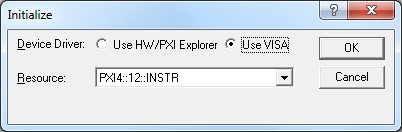
Initialize Dialog Box using VISA resources
After the board is initialized the panel is enabled and will display the current setting of the board. The following picture shows the Setup page settings:
The following controls are shown in the Setup page:
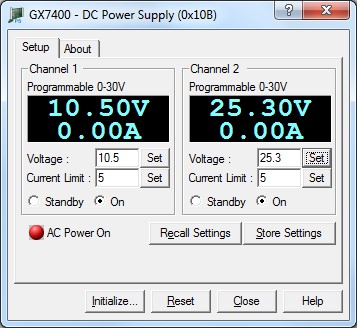
GX7400 Virtual Panel with Options Enabled
Channel Voltage: Sets the voltage for a channel. Enter a positive numeric value (nn.nn format) in the channel's Voltage text box and click Set. Disabled if channel is a fixed module.
Channel Current Limit: Sets the channel's maximum allowable current. Enter a positive numeric value (n.nn format) in the channel's Current Limit text box and click Set. Disabled if channel is a fixed module. . If current limit is set to zero and output is set to On, output voltage is not defined.
Channel Standby/On: Sets/display channel's Standby or On state. When set to ON the output voltage is measured and displayed. When in Standby the output voltage is zero.
Recall Settings: Recalls and applies all installed channels parameters from the on-board EEPROM. The EEPROM stores the voltage, current limit and the On/Standby state for all installed channels when pushing the Store button.
Store Settings: Stores all installed channels parameters to the on-board EEPROM. The EEPROM will store the voltage, current limit and the On/Standby state for all installed channels.
AC Power On: Indicate whether the AC power switch is either set to On or Off position.
Clicking on the About tab will show the About page as shown in the figure below:
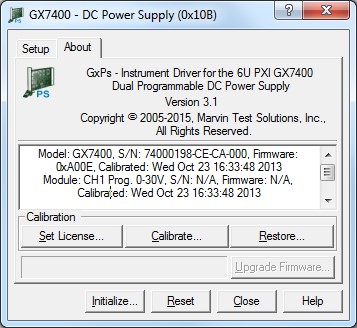
GX7400 Virtual Panel – About Page
The top part of the About page displays version and copyright of the GXPS driver. The bottom part displays the board summary, including the board Revision, calibration date and installed channels description. The About page also contains a button Upgrade Firmware… used to upgrade the board FPGA. This button maybe used only when the board requires upgrade as directed by Marvin Test Solutions support. The upgrade requires a firmware file (.jam) that is written to the board FPGA. After the upgrade is complete you must shut down the computer to recycle power to the board.
Calibration (group box):
Set License… button opens the License Setup dialog, see In System Calibration for details.
Calibration…button opens the calibration by user dialog. see In System Calibration for details.
Restore…. button restores the specified channel’s calibration data back to the manufacture data.