
The ID[n] lines are for signals that are used for identification of the module board. Each line has a pull-up and each module card should tie a unique combination of these lines to ground. There are 15 combinations available. The value of 0xF is reserved for indicating no module card is installed.
The DIO[n] lines are eight signals that are general purpose LVTTL discrete I/O. Each line can be programmed to drive high, drive low or hi-z. The status of each line can be read at any time.
The serial control link is similar in functionality to the SPI interface bus. There are seven Sxxxx signals used for a serial communication link to the module or module board. SClk is the serial clock signal driven by the GX6196. SDOut carries the serial data from the module board to the GX6196. SDIn carries the serial data from the GX6196 to the module board. There are four SCSn[n] active low Chip Select signals which are used to select which device on the module board is communicating with the serial bus.
The GX6196 supports automatic serial transaction of 16 bits at a1MHz rate via the function call Gx6196SendReceiveModule . The figure below 3-5 details the timing of the serial interface:
Serial Interface Timing Diagram
Power is drawn from the PXI backplane so power requirement of other cards may affect the maximum current available for the module board.
Voltage |
Nominal Current |
Maximum Current |
+5V |
1A |
5A |
+3.3V |
2A |
5A |
+12V |
0.5A |
1A |
-12V |
0.25A |
1A |
+1.2V |
0.5A |
1A |
Power requirements from backplane
The figure below provides an outline drawing of the module board. For users designing their own module board, Marvin Test Solutions can supply an electronic file detailing this board’s outline and critical dimensions:
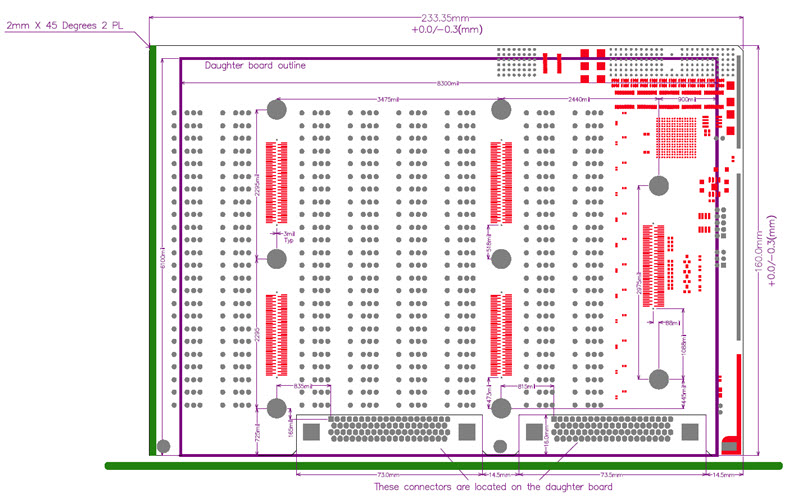
GX6196 Line Drawing of Board Layout