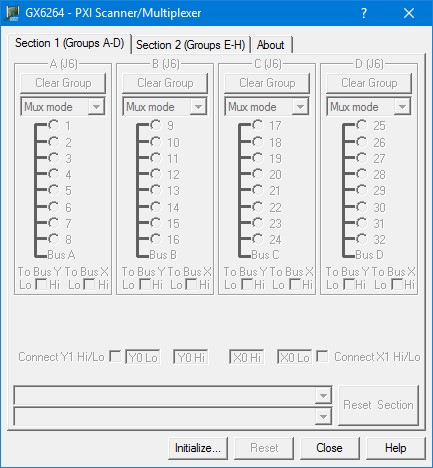
The GX6264 includes a virtual panel program, which enables full utilization of the various configurations and controlling modes. To fully understand the front panel operation, it is best to become familiar with the functionality of the board.
To open the virtual panel application, select GX6264 Panel from the Marvin Test Solutions, GXSW menu under the Start menu. The GX6264 virtual panel opens as shown here:
GX6264 Virtual Panel
The following controls are shown:
Initialize Opens the Initialize Dialog (see Initialize Dialog paragraph) in order to initialize the board driver. The current settings of the selected counter will not change after calling initialize. The panel will reflect the current settings of the counter after the Initialize dialog closes.
Reset: Resets all relays to an open state and sets panel parameters to the default state.
Close: Closes (exits) the GX6264 panel.
Help: Opens the GX6264 on-line help window.
The Initialize dialog initializes the driver for the selected counter board. The counter settings will not change after initialize is called. Once initialize, the panel will reflect the current settings of the counter.
The Initialize dialog supports two different device drivers that can be used to access and control the board:
1. Use Marvin Test Solutions’ HW – this is the device driver installed by the setup program and is the default driver. When selected, the Slot Number list displays the available counter boards installed in the system and their slots. The chassis, slots, devices and their resources are also displayed by the HW resource manager, PXI/PCI Explorer applet that can be opened from the Windows Control Panel. The PXI/PCI Explorer can be used to configure the system chassis, controllers, slots and devices. The configuration is saved to PXISYS.INI and PXIeSYS.INI located in the Windows folder. These configuration files are also used by VISA. The following figure shows the slot number 0x103 (chassis 1 Slot 3). This is the slot number argument (nSlot) passed by the panel when calling the driver Gx6264Initialize function used to initialize driver with the specified board.
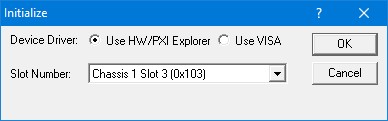
Initialize Dialog Box using Marvin Test Solutions’ HW driver
2. Use VISA – this is a third party device driver usually provided by National Instrument (NI-VISA). When selected, the Resource list displays the available boards installed in the system and their VISA resource address. The chassis, slots, devices and their resources are also displayed by the VISA resource manager, Measurement & Automation (NI-MAX) and in Marvin Test Solutions PXI/PCI Explorer. The following figure shows PXI9::14::INSTR as the VISA resource (PCI bus 9 and Device 14). This is VISA resource string argument (szVisaResource) passed by the panel when calling the driver Gx6264InitializeVisa function to initialize the driver with the specified board.
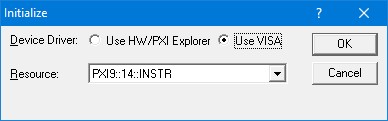
Initialize Dialog Box using VISA resources
After the board initialized the virtual panel is enabled and displays the board setting. The following picture shows the Section Groups page settings:
.jpg "GX6264 Virtual Panel (Initialized)")
GX6264 Virtual Panel (Initialized)
The following controls are shown in the Section Groups page:
Groups A-D or Groups E-H: specific scan groups to be connected or opened. Each group can be set to operate in Multiplexer or Matrix mode. In Multiplexer mode one relay in a group can be closed at any one time by clicking next to the relay number. In Matrix mode any or all of the group relays can be connected. Connected relay is marked by a dot appearing next to the relay number.
Clear Group (button): Open all relays in the associated scan group and set the group mode to Multiplexer.
Group Mode Drop Down List Box: Select the group operation mode, either Multiplexer (default) or Matrix.
Connecting a Relay to a Scan Group Bus. The figure below shows relays connected to their scan group bus. To connect one of the relays in one of eight scan groups to a group bus, click on the relay to be connected to the bus. Only one relay in a scan group can be closed at a time. When a box is checked its specific relay is closed. Similarly, unchecked boxes denote open relays that are not connected to any bus.
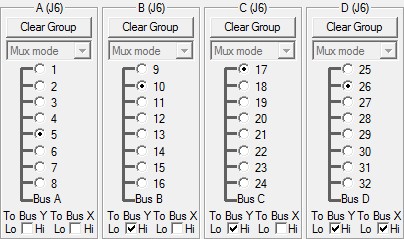
Connecting Relays to Group Buses
Clearing Connections (relay to group bus). To clear connection to the specific scan group bus, click the Clear Group button in the appropriate group column.
|
Caution - When connecting a group to X or Y buses, any other group that is connected to the bus will automatically be connected. |
Reset Section: Opens all relays in the current displayed section.
X/Y Buses Check Boxes (8): Connect the displayed scan groups to the external X bus and Y bus; see Figure 1 8. When a box is checked its relays are connected to the bus. Similarly, unchecked boxes denote open relays that are not connected.
Bus X0 (X1 –Section 2) Mode Drop Down List Box: This drop-down list box used to select the current bus mode. These options are identical for scan groups A D and scan groups E–H. These modes are:
● Not In Use – The X0 bus is disconnected from the outside world. Groups can still be connected together using the X0 bus internally.
● Differential – Any of the scan groups can be connected to the X0 bus providing a direct access to up to 64 differential channels.
● X0 Single Ended Hi – Single ended high mode The high input of any group will be connected to high side of X0 bus. The low side of X0 bus is disconnected, shorted to the high side of X0 bus or to ground depending on the jumper setting
● X0 Single Ended Lo – Single ended low mode. The low inputs of any scan group will be connected to high side of X0 bus. The low side of X0 bus is disconnected, shorted to the high side of X0 bus or shorted to ground depending on the jumper setting.
● X0 Single Ended Lo Ch Lo– Single ended low to channel low mode. The low inputs of any scan group will be connected to low side of X0 bus. The low side of X0 bus is disconnected, shorted to the high side of X0 bus or shorted to ground depending on the jumper setting.
Bus Y0 (Y1 –Section 2) Mode Drop Down List box – This drop-down list box used to select the current bus mode. These options are identical for scan group A D and scan group E–H. The modes are:
● Not In Use – The Y0 Bus is disconnected from the outside world. Groups can still be connected together using the Y0 bus internally.
● Differential – Any of the scan groups can be connected to the Y0 Bus providing a direct access to up to 64 differential channels.
● Y0 Single Ended Hi – Single ended high mode. The high inputs of any scan group will be connected to high side of Y0 bus. The low side of Y0 bus is disconnected, shorted to the high side of Y0 bus or to ground depending on the jumper setting.
● Y0 Single Ended Lo – Single ended low mode. The low inputs of any scan group will be connected to high side of Y0 bus. The low side of Y0 bus is disconnected, shorted to the high side of Y0 bus or shorted to ground depending on the jumper setting.
● Y0 Single Ended Lo Ch Lo– Single ended low to channel low mode. The low inputs of any scan group will be connected to low side of Y0 bus. The low side of Y0 bus is disconnected, shorted to the high side of Y0 bus or shorted to ground depending on the jumper setting.
X1/Y1(Section 1) or X0/Y0 (Section 2) Check Boxes: Used to connect the sections bus.
Clicking on the About tab will show the About page as shown in the figure below:
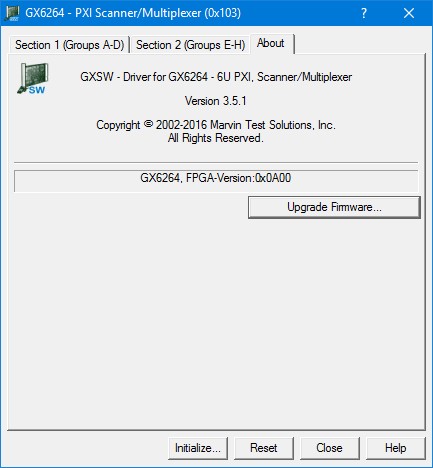
GX6264 Virtual Panel – About Page
The top part of the About page displays version and copyright of the GX6264 driver. The bottom part displays the board summary and the FPGA version. The About page also contains a button Upgrade Firmware… used to upgrade the board FPGA. This button maybe used only when the board requires upgrade as directed by Marvin Test Solutions support. The upgrade requires a firmware file (.jam) that is written to the board FPGA. After the upgrade is complete you must shut down the computer to recycle power to the board.
Connecting a Scan Group to X Bus and/or Y Bus. To connect a scan group to an X bus or Y bus click on the appropriate box below the scan group to be connected. Each scan group connection has two checkboxes, one for X bus and one for Y bus.
Connecting X0 Bus to X1 Bus and/or Y0 Bus to Y1 Bus. To connect the X bus or Y bus from each section to each other, click the checkbox marked respectively X1 or Y1 in Section 1 tab or X0 or Y0 in Section 2 tab.
Changing X Bus or Y Bus Mode. The X bus and the Y bus modes can be changed independently of each other as follows:
Click on the X bus or the Y bus mode drop-down box.
The following options are available from the mode drop-down box:
● Not In Use - The X bus is disconnected from the outside world. Groups can still be connected together using X or Y bus internally.
● Differential - Any of the scan groups can be connected to the Y bus providing a direct access to up to 64 differential channels.
● Single Ended Hi - Single ended high mode. The high inputs of any scan group will be connected to high side of X or Y bus. The low side of X or Y bus is disconnected, shorted to the high side of Y bus or to ground depending on the jumper setting.
● Single Ended Lo - Single ended low mode. The low inputs of any scan group will be connected to high side of X or Y bus. The low side of X or Y bus is disconnected, shorted to the high side of Y bus or shorted to ground depending on the jumper setting.
Resetting the Board. Resetting the GX6264 board opens all relays and disconnects all buses and groups. Panel parameters are set to the default state. To reset the entire board, click the Reset All button in the panel dialog box.
Help/About Information. To obtain Help or About information when using the virtual panel, click the right mouse button anywhere on the caption bar of the panel window, or press the F1 key. A popup menu will display the Help and About options. Use the About dialog box to get the version number of the software you are using.
Closing the Virtual Panel. Click the Close button to close the virtual panel.
