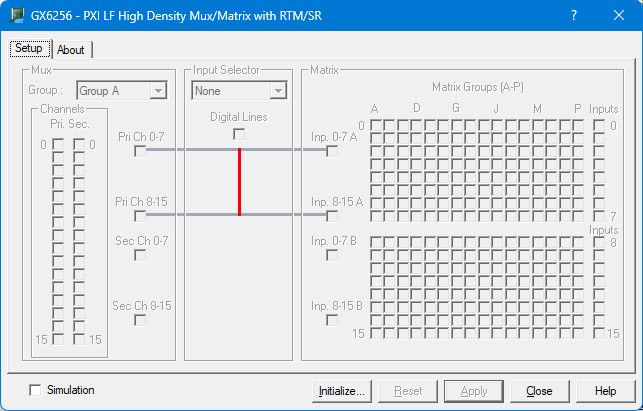
The GXSW software includes a virtual panel program, which provides full access to the various configuration settings and operating modes. To fully understand the front panel operation, it is best to become familiar with the functionality of the board.
To open the virtual panel application, select GX7016 Panel from the Marvin Test Solutions, GXSW menu under the Start menu. The GX7016 virtual panel will be your system and will show all the GX6256/GX6192/GX6864/GX6032/GX6009 installed in your system, each card will show in its own page as shown here:
Virtual Panel - Uninitialized
Simulation – Selects simulation mode. When the check box is checked when the Initialize button is clicked, the panel will operate in simulation mode. If the check box is not checked when the Initialize button is clicked, the panel will control actual hardware.
Initialize – Scans the current system for any components of the GX7016 switching sub system (GX6256, GX6192, GX6864, GX6009, and GX6032) and initializes each one. The current settings of each device will not change after calling initialize. The panel will reflect the current settings of each device.
Reset – Resets the device settings of the device that corresponds to the currently active page, to their default state.
Apply – Applies changed settings to the board.
Close – Closes the panel. Closing the panel does not affect the board settings.
Help – Opens the on-line help window. In addition to the help menu, the caption shows a What’s This Help button (?) button. This button can be used to obtain help on any control that is displayed in the panel window. To displays the What’s This Help information click on the (?) button and then click on the control – a small window will display the information regarding this control.
After the board is initialized, the panel is enabled and will display the current setting of the board. The following picture shows the LF Slot Page, 2-LF (LF PXI card that is installed on PXI Slot #2) settings:
_Page.jpg "Virtual Panel – LF (GX6256) Page")
Virtual Panel – LF (GX6256) Page
The following controls are shown:
Mux Group Selection (combo box): Set/Displays the currently selected Mux Group
Channels (check boxes): Displays the current relay setting (closed or open). When a box in the matrix is checked, the relay in that row/column is closed. Similarly, unchecked boxes mean relays are open.
Input Selector (combo box): Sets/Displays the currently selected input selector mode
None: The Mux, Matrix, and external lines are not connected to each other.
Matrix Only: The Mux and Matrix are allowed to connect but the external lines are disconnected.
Ext. Only: The Mux and the external lines are allowed to connect to each other.
Matrix and Ext.: The Mux is allowed to connect to the Matrix and external lines.
Matrix Isolated: The Mux is not allowed to connect to the selector, effectively making it isolated from the rest of the board.
Digital (Ext.) (check box): Displays the state of the connection between the digital external input and the input selector
Pri Ch 0-7 (check box): Displays the state of the connection between the primary mux low channels to the input selector
Pri Ch 8-15 (check box): Displays the state of the connection between the primary mux high channels to the input selector
Sec Ch 0-7 (check box): Displays the state of the connection between the secondary mux low channels to the input selector
Sec Ch 8-15 (check box): Displays the state of the connection between the secondary mux high channels to the input selector
Inp. Ch 0-7 (check box): Displays the state of the connection between the matrix low channels to the input selector
Inp. Ch 8-15 (check box): Displays the state of the connection between the matrix high channels to the input selector
Matrix (check boxes): Sets/Displays the states of each of the GX6256 Matrix relays. If the check box is checked, the associated relay is closed. If the check box is not checked, the associated relay is open.
Inputs (check boxes): Sets/Displays the states of each of the global bus input relays. If the check box is checked, the associated relay is closed. If the check box is not checked, the associated relay is open.
The following picture shows the HF Slot Page, 19-HF (HF PXI card that is installed on PXI Slot #19) settings:
_Page.jpg "Virtual Panel – HF (GX6192) Page")
Virtual Panel – HF (GX6192) Page
The following controls are shown:
Mux Group Selection (combo box): Set/Displays the currently selected Mux Group
Channels (check boxes): Displays the current relay setting (closed or open). When a box in the matrix is checked, the relay in that row/column is closed. Similarly, unchecked boxes mean relays are open.
Input Selector (combo box): Sets/Displays the currently selected input selector mode
None: The Mux, Matrix, and external lines are not connected to each other.
Matrix Only: The Mux and Matrix are allowed to connect but the external lines are disconnected.
Ext. Only: The Mux and the external lines are allowed to connect to each other.
Matrix and Ext.: The Mux is allowed to connect to the Matrix and external lines.
Matrix Isolated: The Mux is not allowed to connect to the selector, effectively making it isolated from the rest of the board.
Global Bus (Ext.) (check box): Displays the state of the connection between the global bus external input and the input selector
Pri Ch 0-5 (check box): Displays the state of the connection between the primary mux low channels to the input selector
Pri Ch 6-11 (check box): Displays the state of the connection between the primary mux high channels to the input selector
Inp. Ch 0-7 (check box): Displays the state of the connection between the matrix low channels to the input selector
Inp. Ch 8-15 (check box): Displays the state of the connection between the matrix high channels to the input selector
Matrix (check boxes): Sets/Displays the states of each of the GX6192 Matrix relays. If the check box is checked, the associated relay is closed. If the check box is not checked, the associated relay is open.
Inputs (check boxes): Sets/Displays the states of each of the instrument input relays. If the check box is checked, the associated relay is closed. If the check box is not checked, the associated relay is open.
Show Names (check box): Shows/Hides the logical names that have been applied to the instrument inputs.
The following picture shows the VF Slot Page, 19-HF (VF PXI card that is installed on PXI Slot #5) settings:
_Page.jpg "Virtual Panel – VF (GX6864) Page")
Virtual Panel – VF (GX6864) Page
The following controls are shown:
Mux Group Selection (combo box): Set/Displays the currently selected Mux Group
Channels (check boxes): Displays the current relay setting (closed or open). When a box in the matrix is checked, the relay in that row/column is closed. Similarly, unchecked boxes mean relays are open.
Input Selector (combo box): Sets/Displays the currently selected input selector mode
None: The Mux, Matrix, and external lines are not connected to each other.
Matrix Only: The Mux and Matrix are allowed to connect but the external lines are disconnected.
Ext. Only: The Mux and the external lines are allowed to connect to each other.
Matrix and Ext.: The Mux is allowed to connect to the Matrix and external lines.
Matrix Isolated: The Mux is not allowed to connect to the selector, effectively making it isolated from the rest of the board.
Video input (check box): Displays the state of the connection between the external video inputs and the input selector
Input 0-3 (check box): Displays the state of the connection between the matrix channels 0-3 to the input selector
Input 4-7 (check box): Displays the state of the connection between the matrix channels 4-7 to the input selector
Input 8-11 (check box): Displays the state of the connection between the matrix channels 8-11 to the input selector
Input 12-15 (check box): Displays the state of the connection between the matrix channels 12-15 to the input selector
Matrix (check boxes): Sets/Displays the states of each of the GX6864 Matrix relays. If the check box is checked, the associated relay is closed. If the check box is not checked, the associated relay is open.
Inputs (check boxes): Sets/Displays the states of each of the instrument input relays. If the check box is checked, the associated relay is closed. If the check box is not checked, the associated relay is open.
The following picture shows the RTM page, 2-RTM (RTM module that is installed on PXI backplane on slot #2, controlled using 2-LF) settings:
_Page.jpg "Virtual Panel - Rear Transition Module (GX6032) Page")
Virtual Panel - Rear Transition Module (GX6032) Page
The following controls are shown:
Rear Transition Board Matrix (check boxes): Sets/Displays the states of each of the rear transition module relays. If the check box is checked, the associated relay is closed. If the check box is not checked, the associated relay is open.
The following picture shows the SR page, 2-SR (SR module that is installed on PXI backplane on slot #2, controlled using 2-LF) settings:
_Page.jpg "Virtual Panel - Switching Router Module (GX6009) Page")
Virtual Panel - Switching Router Module (GX6009) Page
The following controls are shown:
Slot Global Bus (check boxes): Sets/Displays the states of each of the switch router relays. If the check box is checked, the associated relay is closed. If the check box is not checked, the associated relay is open. Each relay corresponds to a particular global bus line (0-15).
Common Relays Global Bus Selection (combo box): Set/Displays the currently selected global bus line
Slots 2:4 and Common 1 (check boxes): Displays the status of the relay that connects slots 2, 3, and 4 to the other slots
Slots 5:7 and Common 2 (check boxes): Displays the status of the relay that connects slots 5, 6, and 7 to the other slots
Slots 8:10 and Common 3 (check boxes): Displays the status of the relay that connects slots 8, 9, and 10 to the other slots
Inter SR (check box): Displays the status of the relay that connects this switch router to the other switch router
Clicking on the Relay Count tab will show the Relay Count Page as shown in the figure below:
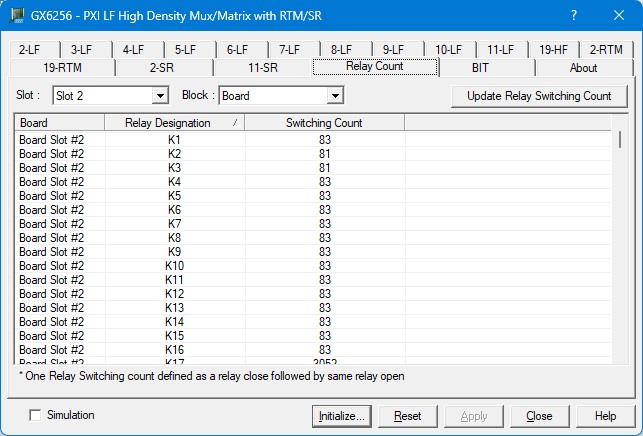
Virtual Panel – Relay Count Page
The following controls are shown in the Relay Count page:
● Slot Selection (combo box): Set/Displays the currently selected board's slot
● Block Selection (combo box): Sets/Displays the currently selected block (board, RTM, or SR) of the currently selected board
● Board: Show relays that are located only on the board (GX6256/GX6192/GX6864) that resides in the selected slot.
● RTM: Show relays that are located only on the Rear Transition Module (GX6032) that resides in the selected slot.
● Switch Router: Show relays that are located only on the Switch Router (GX6009) that resides in the selected slot.
● Update Relay Switching Count (button): This button retrieves the latest Relay Switching Count data from the board and automatically update the Relay Count List. Once updated, the list is sorted by Relay Designation number in ascending order (lowest to highest).
● Relay Count List (list control): Displays the number of openings and closures of each relay within the currently selected block of the currently selected board (slot). All columns in the Relay Count list are sortable. To sort the table, click any column header at the top; the list will automatically reorder based on that column. Click the same header again to reverse the sort direction. An arrow in the column header indicates the current order: ▲ Ascending (A–Z, 0–9, oldest–newest) or ▼ Descending (Z–A, 9–0, newest–oldest). To sort by a different column, click its header—the previous sorting will be cleared and the newly selected column will become the active sort column.
Clicking on the BIT tab will show the BIT Page as shown here:
_Page.jpg "Virtual Panel - Built In Test (BIT) Page")
Virtual Panel - Built In Test (BIT) Page
The following controls are shown in the Built In Test (BIT) page:
Slot Selection (combo box): Set/Displays the currently selected board's slot
Run Button (button): Starts running the Built In Test (BIT)
Abort Button (button): Aborts a currently running Built In Test (BIT)
Built In Test Results (text box): Displays the results of the last completed Built In Test (BIT)
Clicking on the About tab will show the About Page as shown in the figure below:
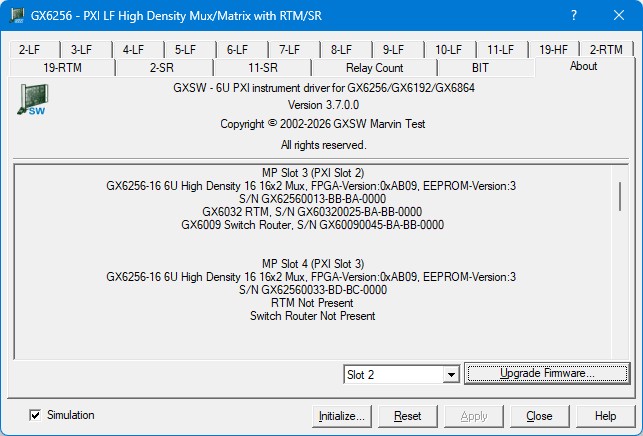
Virtual Panel – About Page
The following controls are shown in the About page:
The top part of the About page displays version and copyright of the GXSW driver. The bottom part displays the board summary.
The About page also contains a button Upgrade Firmware… which is used to upgrade the board’s FPGA firmware. This button maybe used only when the board requires upgrade as directed by Marvin Test Solutions support. The upgrade requires a firmware file (.jam) that is written to the board FPGA. After the upgrade is complete, you must shut down the computer to recycle power to the board.
Slot Selection (combo box): Set/Displays the currently selected board's slot for upgrading firmware.