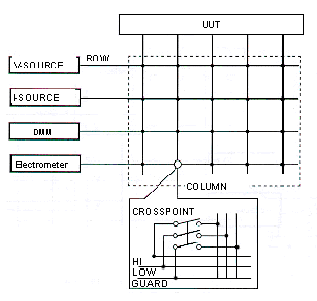
The matrix topology is used to connect any input to any output. Simultaneous connections are possible with one input driving many outputs or, less often, several inputs driving one output. The most common terminology to describe matrix size is by rows and columns. As shown in the figure below, any row can be connected to any column by closure of the relay at the intersection (crosspoint) of a row and column. This flexibility of the connections is the main advantage of a matrix switching system. The matrix topology connects multiple instruments to multiple points on a UUT, or multiple instruments to multiple UUTs. Direct connections between source and measure instruments are also possible.
The figure below (exploded view) illustrates a crosspoint implementing a 3-pole, Form A, switching of high, low, and guard signals. This type of structure permits maximum flexibility when connecting instruments and the UUT to the matrix. When designing the matrix, the number of poles per crosspoint is related to how the instruments are connected to the matrix. Single-pole matrix switching is the most common type.
Marvin Test Solutions' GX6616 is true switch matrix that may be used in the examples shown in figures Matrix Topology, Single-Pole Matrix, Two-Pole Matrix. These products offer a single-ended configuration of up to 6 rows by 16 columns or 2 rows by 96 columns. In the differential (2 wire) configuration, these products may be used to switch 3 rows by 16 columns or 2 rows by 48 columns. Using several boards, these products may be used to create unlimited switch matrices.
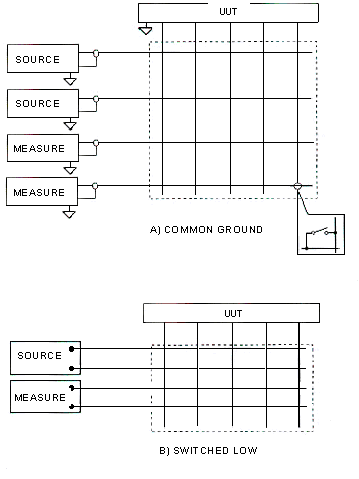
In switching matrices, two connection methods can be used, as shown in the figure below. The common ground system is used in high frequency systems where low impedance returns and coaxial cabling are required. The switched low configuration is used in low frequency or DC applications where floating measurements are required
.
Two-pole matrix switching is used for differential (balanced) systems or to make 4-wire measurements. An example is shown in the figure below where a combined source/measure instrument (DMM) makes a 4-wire measurement using two 2-pole rows of the matrix.
The 2-pole configuration is also used for guarded source or measure connections involving high impedance or low-level signals as shown in the figure below. Since guarding isolates sensitive lines from adjacent circuitry, the construction and wiring of hardware for guarded systems differs from that used in a general-purpose 2-wire matrix.
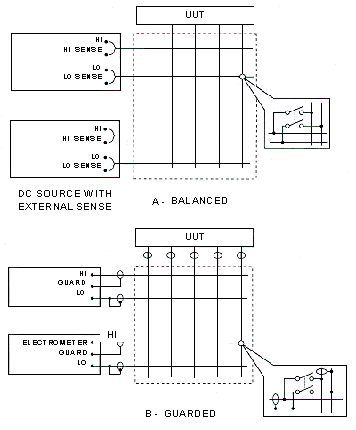
For sensitive measuring applications, the 3-pole matrix switching method is useful. The 3-pole method isolates the high and low signals from the other signals. This is done by additional shielding which is not at circuit low or earth potential.
The 3-pole configuration is also used for isolating source/measure signal pairs with a driven shield (guard).
Switching matrices may be used as a building block for larger matrices by interconnecting them along the columns or rows. Matrix blocks can be connected to form a long narrow matrix. This is useful when a large number of instruments and UUT connections are required, but only a few signals are used for each test step.
As the following points illustrate, the matrix topology is the most efficient method because it offers:
Reduced hardware and cost
Straight forward programming
Maximum switching flexibility via software control
Maximum test flexibility to run different devices or different test programs. However, there are several drawbacks to matrix switching:
Safety considerations. It is difficult to confine hazardous signals to certain paths.
Increased cross talk between paths. Shunt loading and impedance matching limits bandwidth.
Additional cost of switches for every possible signal path.
Lower reliability. More switches and increased possibility of misconnection.