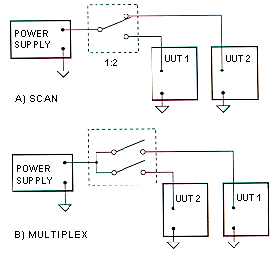
Most scan and multiplex topologies connect one input to "n" outputs or "n" inputs to one output. These are the most commonly used topologies in signal switching for small systems. The simplest scanner is a Form C contact as shown in part A of the figure below, switching a supply to either of two loads. Implementing this with two Form A contacts gives a simple multiplexer. The supply can now be connected to either one or both loads as seen in part B of the figure below.
The major advantages of multiplexing over scanning are:
Multiplexing permits an all-open state.
Multiplexing permits any order. Scanning is sequential.
Multiplexing allows simultaneous connections. Scanning does not.
Basic Scan/Multiplex
The multiplexing method is the most used because provides it the most flexibility. In addition, sequencing of multiplex connections can be programmed in any order. Scanning is most often used in stand-alone systems without computer control. When designing a multiplex test system, the designer must consider the consequences of simultaneous connections in the system in case of software error or hardware failure (stuck relay). Various strategies can be used to handle this, from reconfiguring the switching or adding protection circuitry to adding software checks in the test program.
Multiplexing and Scanning are used in a test system to connect one instrument to multiple UUTs or multiple instruments to one UUT. Sample configurations are shown in the figures below. The upper figure shows 2-pole multiplexing of high and low connections to the UUT. The same hardware can be used as both the 1:N and N:l blocks. The lower figure shows a ground-referenced system with 1-pole switching. Two additional multiplexers are used to connect the same instruments to a second UUT.
Marvin Test Solutions' GX6264, GX6315, and GX6338 may be used in the examples shown in the figures above, and the two figures below. The GX6264 offers programmable configuration of differential (2 wire) and single-ended (one wire).
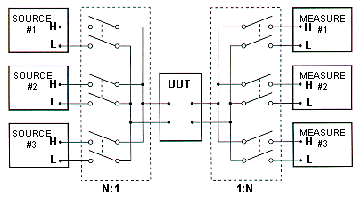
Two-Pole Multiplexing
For multiplexed switching, Form A contacts are used almost exclusively Switch Topology (Form A, B, C)
One and two-pole configurations are common, with more poles used in special situations (i.e. guarding).
Configurations equivalent to multiple pole configurations can be built from single-pole multiplexers controlled together. However, proper shielding, guarding, and noise cancellation are often more difficult. Control can also be synchronized to implement a 1:N/N:l switched pair.
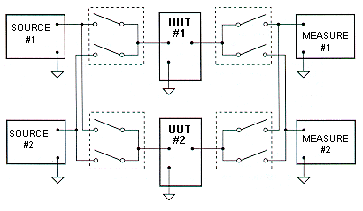
One Pole Multiplexing