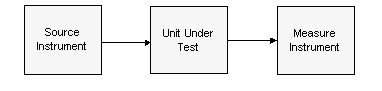
To effectively test a device, component, or subassembly involves monitoring its response to a set of prescribed input conditions. Testing generally means applying a stimulus to a unit under test and checking the response, as shown in the figure below.
A Simple Test System
Almost all stimulus and response signals are electrical, but they could be non-electrical, such as heat, light, or motion. Non-electrical signals are usually converted to, or from, electrical signals to permit computer control or data analysis. Electrical signals are measured, or sourced, by the following common test instruments:
Measure - Oscilloscope, voltmeter, frequency counter, spectrum analyzer, waveform analyzer.
Source - Power supply, current source, pattern generator, pulse generator, or frequency synthesizer.
Source/Measure - Ohmmeter, capacitance meter, network analyzer, signature analyzer.
Measure and source functions can be combined in the same instrument and even in the same leads, for example, an ohmmeter that measures voltage and source current on two leads.
In basic test systems, the source and measure instruments are connected to the unit under test (UUT) by direct interface wiring. A better test system makes these connections via switching. The purpose of employing a switching system is to:
Test several UUTs during one test session.
Test multiple points on a UUT.
Connect many measure or source instruments.
The various configurations are shown below. The basic configurations may be combined to form more complex systems. In most systems, it is best to measure the output of the source instruments directly. This feature may require additional switching.
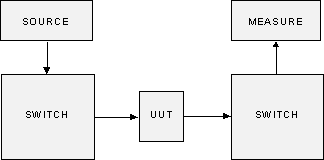
Multiple Test Points
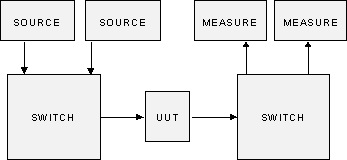
Multiple Instruments
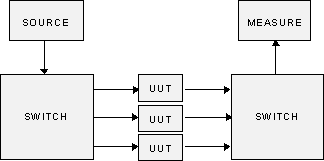
Multiple UUTs