Relay coil power is the amount of power in watts needed to actuate the relay. A reed switch or the armature of an electromechanical relay requires a set amp-turns product to actuate the relay. Many turns of fine wire are used to keep the necessary current and power to a minimum.
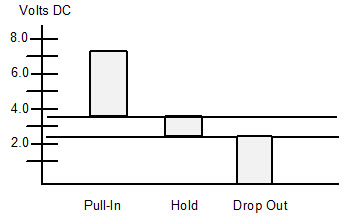
The amp-turns requirement and the resistance of the coil also determine the pull-in, hold, and dropout voltages. These are shown for a typical 5V DC relay in the figure below. Often more power is needed to actuate a relay than to maintain a given state. Once the switch is closed, the magnetic path has a lower reluctance. A lower reluctance means a weaker field can hold the switch closed.
As with any wire, the coil's resistance changes with temperature. This affects the pull-in voltage, as shown in the figure below.
Coil Voltage Levels
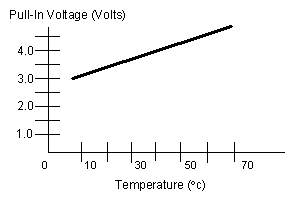
Pull-in vs Temperature
A relay coil also produces inductance because it is a coil of wire. As an inductor, the current in the coil cannot be changed instantaneously, since V=L(di/dt), without generating an excessive voltage spike. A diode is often used across the coil with the cathode at the positive voltage end of the coil. The suppression or "back" diode will conduct the coil current when the relay drive is removed. See Figure below:
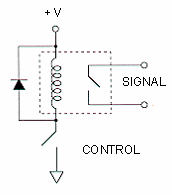
Suppression Diode