When designing the switching portion of a given system, it is important to define the configuration and implementation of the individual switches.
There are three terms used to describe switch configurations:
Number of poles (e.g. Single/double/triple Pole).
Single/double Throw
Contact Form
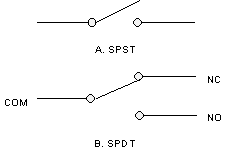
The term pole refers to the number of common terminals contained within a given switch. The figure below shows a single-pole switch in the open position. The term throw refers to the number of positions in which the switch may be placed that create a signal path or connection. A complete description of the figure below part A would then be single-pole, single-throw, normally-open (SPSTNO).
Part B in the figure below shows a single-pole, double-throw (SPDT) switch. One terminal in part B in the figure below is normally-open (NO) and the other is normally-closed (NC). Only one of the terminals is connected, depending on the state of the switch. A complete description of part B in the figure below would then be Single Pole, Double Throw (SPDT).
Single Pole Schematics
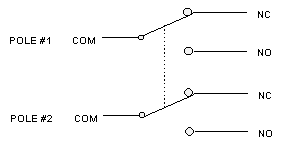
The figure below shows a double-pole, double-throw (DPDT) switch. Both poles are actuated simultaneously when the relay is energized.
The "form", or "contact form", is a term used by relay manufacturers to describe the contact configuration of a relay. "Form A" refers to a single-throw, normally-open switch. "Form B" refers to a single-throw, normally-closed switch, and "Form C" indicates a double-throw switch. An alternate designation for a double throw switch is a Change Over (CO). Using this nomenclature scheme, virtually any contact configuration may be described.
DPDT Schematic