These basic steps are required to install and configure a DIO board in the host PXI computer/chassis. Complex steps are further explained in the following Specific Procedures section.
Before installing a DIO board, configure it as follows (See detailed procedures in the following Specific Procedures section):
1. Tag each board or record its serial number.
2. Set unique board number for each new DIO board using the selector switch on the front. See Specific Procedures.
3. Install or upgrade SIMMs as necessary. See Specific Procedures.
4. Mount a Timing Module to configure a Master as necessary. See Specific Procedures.
5. Mount I/O Modules as necessary. See Specific Procedures.
6. Lay boards out in slot order with the master in the middle (the Master should have equal number of Slaves from both sides).
The following Installing a Board, Plug & Play Driver Installation, Removing a Board, Board Selector Switch Settings, Connecting Timing cable, Installing Memory, Installing I/O Modules and sections explain Specific Procedures.
Install the GX515x board as follows:
1. Install first the GTDIO driver as explain in the Software User's Guide.
2. Turn off the PXI chassis and unplug the power cord.
3. Set the board selector switch settings if required. See Board Selector Switch Settings for details on switch settings before the installation.
4. Locate a PXI empty slot in the PXI chassis.
5. Place the board edges into the PXI chassis rails (top and bottom).
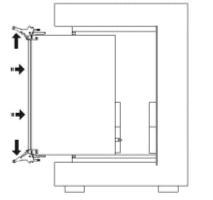
6. Carefully slide the PXI board to the rear of the chassis, make sure that the ejector handles are pushed out (as shown in the figure below).
Ejector handles position during module insertion
7. After you feel resistance, push in the ejector handles as shown in the figure below to secure the module into the frame.
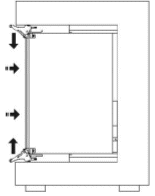
Ejector handles position after module insertion
8. Tighten the board’s front panel screws to the chassis (located at both edges of the board).
9. Connect any necessary cables to the GX515x boards.
10. Plug the power cord in and turn on the PXI chassis.
Plug & Play operating systems such as Windows notify the user that a new board was found. If already installed, Windows will suggest using the driver information file: HW.INF.
The file is located in your Windows INF directory. Click Next to confirm and follow the instructions on the screen to complete the driver installation.
If the operating system was unable to find the driver (since the GTDIO driver was not installed prior to the board installation), you may click on the Have Disk button and browse to select the \\Program Files\Marvin Test Solutions\HW installation directory where the HW.INF is located.
If you are unable to locate the Plug & Play driver (e.g. when using Web installation Package) click Cancel to exit the New Hardware Found Wizard, install the GTDIO driver, reboot your computer and repeat this procedure.
Remove a GX515x board as follows:
1. Turn off the PXI chassis and unplug the power cord.
2. Disconnect and remove any cables/connectors connected to the board.
3. Unscrew the board’s front panel screws to the chassis (located at both edges of the board).
4. Push out the ejector handles and slide the PXI board away from the chassis as shown in the figure below.
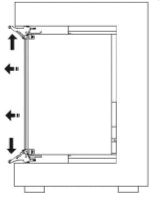
Ejector handles position before module removed
A DIO domain has a Master and Slave boards. In order to configure a DIO domain, each board needs to have a unique number so it can be identify by the software as part of the specified domain, i.e. all Slave boards that belongs to the same Master are in the same domain.
Master (GX5150) |
Has one selector switch on its front faceplate. The selector can be set to any number from 0 to 7 for a total of 8 different DIO domains. |
Slave (GX5151) |
Have two selector switches on its front faceplate. The upper selector switch, designated as “S1 Master #” sets the Master domain that the Slave board belongs to. The lower selector switch designated as “S2 Slave #”, select the Slave number in that domain and can be set to any number from 1 to 7 for a total of 7 Slaves (number 0 is saved for the Master). |
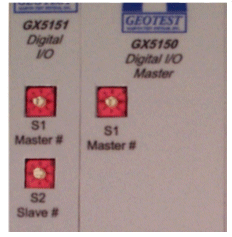
Master and Slave Switch Selectors
Timing cable needs to be installed only if there is at least one Slave board. The Timing cable provides timing and control signals to the Master and Slaves boards in the DIO domain. The Timing connection is Daisy Chain arrangement, similar to SCSI or IDE buses. The Timing cable is a flat cable with 20-pin header connectors. There are two Timing cable connectors on the Master board front panel, J7 and J8, with identical signals. Use J7 connector for Slave boards that are to the left of the Master, use J8 connector for Slave boards that are to the right of the Master. All 20-pin header connectors on the Timing cable should be connected.
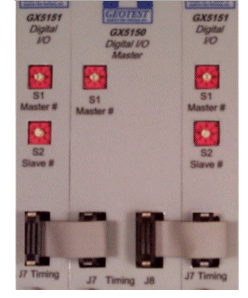
Timing Cable Interconnection
Skip this section if you are not adding or reconfiguring memory.
This section covers SIMMs (single in-line memory modules) used for data and control memory functions.
Note: DIO SIMM modules are specially made for Marvin Test Solutions in order to match the DIO’s unparallel high performance stand-alone capabilities. |
GX515x DIO boards use nine SIMMs. SIMM9 (the figure below) is the Control Memory. SIMM1 – SIMM8 holds Data Memory. SIMM9 (Control) and SIMM1 are the minimum needed for board operation. The Control SIMM occupies the bottom slot labeled “SIMM 9”.
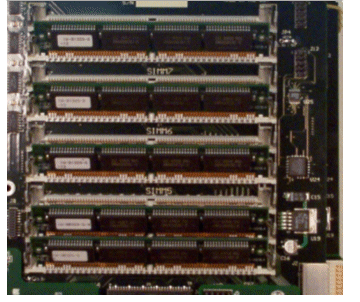
Memory Slots. Install SIMMs in the order specified
When upgrading memory, all DIO SIMMs must have the same size and speed specifications.
Domain performance is limited by the slowest and smallest memory on any DIO board. Therefore, the user is urged to compare test requirements against DIO board memory capabilities and upgrade DIO boards as necessary. This must be done before installing boards.
The following procedure explains how to install SIMMs on a DIO board. This procedure must be implemented with the DIO board removed from the PXI chassis and laying component side up on a suitable bench or work area. Observe safety precautions to avoid damage.
1. If populating memory with all new SIMMs, use the table SIMM Options.
2. If adding to existing memory, select SIMMs identical to the type already installed.
3. Install each SIMM after SIMM 9 (Control) into the lowest numbered vacant socket. Sockets are not located in sequential order, so check the board slot labeling.
4. Carefully set the SIMM over the socket to check orientation. Make certain the SIMM edge connector is aligned with the 72-pin socket. The off-center gap between pins should match. If necessary, rotate the SIMM to align with the socket.
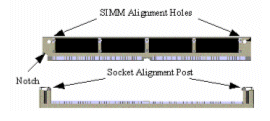
SIMM Module Installation A
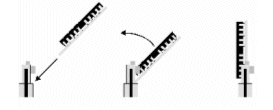
5. With the SIMM aligned and normal to the board, press firmly and rotate downward to a 45-degree angle until it snaps into place. When properly seated, the module “clicks” into place.
6. Assure that all SIMMs are seated correctly and that the metal locking tabs engage on both sides of the SIMM socket.
Notes:
(1) Never force a SIMM into a socket. It is keyed with a notch in the lower right corner. This notch prevents incorrect orientation. If there is difficulty inserting a SIMM, check the alignment.
(2) Damage to SIMM modules and/or sockets may result if proper insertion guidelines are not observed.
(3) SIMMs are extremely sensitive to static electricity. Follow instructions near the beginning of this chapter under Discharge Static Electricity Precautions.
GX515x DIO memory options are listed in the table below.
SIMM Part |
Memory Size & Speed |
Maximum Board Steps (8 SIMMs) |
||
8 Channels |
16 Channels |
32 Channels |
||
GT5006 |
256K, 50MHz |
8M |
4M |
2M |
GT5001 |
1MB, 50MHz |
32M |
16M |
8M |
GT5002 |
2MB, 50MHz |
64M |
32M |
16M |
GT5004-40 |
4MB, 40MHz |
128M |
64M |
32M |
Skip this section unless installing or changing an I/O Module.
I/O Module daughter cards provide special interface functionality between DIO and a UUT, including signal level conversion and high drive power for cables. GX515x DIO boards require an I/O Module to interface with a UUT. A user-selected module is factory installed and tested. For simple five-volt logic, use the GX5910 TTL I/O Module, which uses single-ended +5V logic. See the GX I-O Modules and Interfaces User's Guide (PXI) for more information.
When a DIO board is ordered with an I/O Module, the module is factory installed and tested. Sometimes, however, it is necessary to change the I/O interface or replace one that has been damaged. An I/O Module can be ordered separately and includes mounting hardware.
To mount an I/O Module on a GX5150 (Master), do the following:
1. Remove front faceplate screws holding connectors J1 I/O, J2 I/O and J1 Timing Control.
2. Remove front faceplate by loosening two Phillips screws that are holding the PCB to the ejector handles (at both edges of the GX5150).
3. Remove the two screws that hold the Timing Control (GX5105) with the two risers and remove the Timing Control (GX5105) board.
4. Replace the I/O Module with the new one and press the two connectors, J9 and J10 in place.
5. Carefully insert the two connectors of the Timing Control (GX5105) to their place on the GX5150.
6. Attach the two screws that hold the Timing Control (GX5105) and the risers.
7. Attach the front faceplate two Phillips screws (at both edges of the PCB).
8. Attach screws holding connectors J1 I/O, J2 I/O and J1 Timing Control.
To mount an I/O Module on a GX5151 (Slave), do the following:
1. Remove front faceplate screws holding connectors J1 I/O, J2 I/O.
2. Remove front faceplate by loosening two Phillips screws that are holding the PCB to the ejector handles (at both edges of the PCB).
3. Remove the two screws holding the I/O Module.
4. Replace the I/O Module with the new one and press the two connectors, J9 and J10 in place.
5. Attach the two screws holding the I/O Module.
6. Attach the front faceplate two Phillips screws (at both edges of the PCB).
7. Attach screws holding connectors J1 I/O, J2 I/O.
Reattached the Timing Cable See Connecting Timing cable above. To dismount an I/O Module, reverse this procedure.
When the GX5105 Timing Module is factory installed, skip this procedure. Perform this procedure when replacing a Timing Module or converting a Slave board to a Master.
To reduce propagation delay, the Master should be located near the center of the domain. DIO Boards employ diodes to clip ringing rather than resistive terminators therefore cable termination is not necessary.
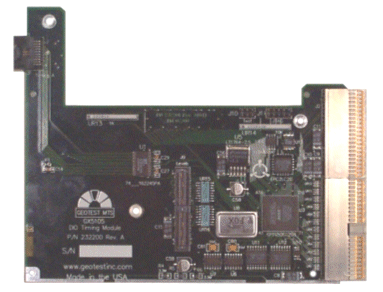
GX5105 Timing Control Board
The GX5105 mounting kit includes the card, mounting hardware and a two-foot UUT timing cable with VHD connectors.
To mount a GX5105 Timing Module, do the following:
1. Remove front faceplate screws holding connectors J1 I/O, J2 I/O.
2. If replacing an existing GX5105 Timing Module, remove front faceplate screws holding connectors J1 Timing Control.
3. Remove front faceplate by loosening two Phillips screws that are holding the PCB to the ejector handles (at both edges of the PCB).
4. Remove the two screws that hold the I/O Module (e.g. GX5910) to the GX5150.
5. Attach a ¾” riser to the GX5150 board between J7 and J8 using a Phillips screw.
6. Connect three 3/8” risers to the GX5105 using 3/8”Phillips screws (covering all screw holes on the GX5105).
7. Attach a GX5101 or any other GX5105 I/O Module to the GX5150.
8. Carefully insert the two connectors of the Timing Control (GX5105) to their place on the GX5150.
9. Attach the two Phillips screws on the GX5105 to the I/O Module (e.g. GX5910) risers.
10. If modifying a GX5151 (Slave) to a GX5150 (Master) replace front faceplate with a GX5150 front faceplate.
11. Attach the front faceplate two Phillips screws (at both edges of the PCB).
12. Attach front faceplate screws holding connectors J1 I/O, J2 I/O and J1 Timing Control.
The Timing Module is now mounted and ready to connect to Slave modules (see General Installation Procedure above).
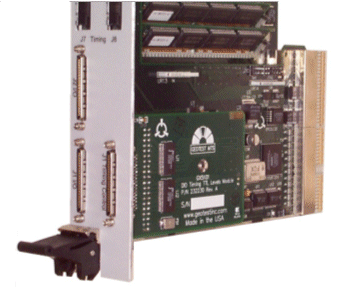
Timing Control Module Installation - Side View