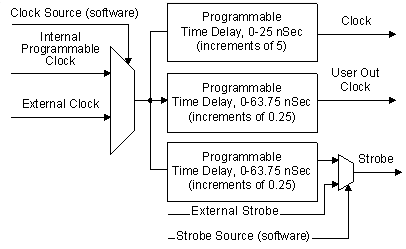
The DIO Timing board (GX5105) controls the clock and strobe signals. All clock and strobe signals are distributed evenly to all DIOs (in the same Maser/Slave domain) through J7 and J8 using the timing cable. See Connecting Timing Cable section above for details.
Clock Source Block Diagram
Timing board has the following clock source signals:
1. Internal Programmable Clock – programmable clock from 5Hz to 50MHz with increments of 1HZ. See Specifications for details.
2. External Clock – supplied by the user through J1 Timing Control, can be from 2MHz to 50MHz. See Specifications for details.
There are three clock signals coming out of the Timing board:
Clock |
The DIO latches output patterns on the IO Module connector on each rising edge of the Clock signal. The Clock can have a delay of 0-25 nSec (with increments of 5) relative to the current clock source. |
User Clock |
This clock signal has the same source and frequency as the Clock but can have a different time delay. The User Clock can have a delay of 0-63.75 nSec (with increments of 0.25) relative to the current clock source. |
Strobe |
The DIO latches input patterns from the IO Module connector on each rising edge of Strobe. When the Strobe source signal is internal, it has the same frequency as the Clock signal. The Strobe can have a delay of 0-63.75 nSec (with increments of 0.25) relative to the current clock source. |
Note: All three available clocks, Clock, User Clock and Strobe can be set to have different time delay relative to their clock source. As a result all three clocks can be shifted in time relative to each other. E.g. the Strobe can come before or after the Clock and vise-versa. The User Clock can help synchronize the DIO with a UUT. Since the User Clock has the same frequency as the Clock signal, it can be shifted in time in order to allow output data to be latched by the UUT at the required time. When operating in frequencies higher then 10 MHz, care should be taken when setting strobe, clock and user clock delays. Some of the delay values may not work for some applications that may result in lost data. |
The timing diagram of the figure below displays Clock and Strobe signals. The DIO board can be driven using either internal or external clock sources. In internal mode, Strobe occurs Ts nanoseconds before the next clock signal (16 nSec default). Ts can be set from 0 – 25 nanoseconds before the Clock signal. In the external mode, Clock or Strobe signals are provided externally.
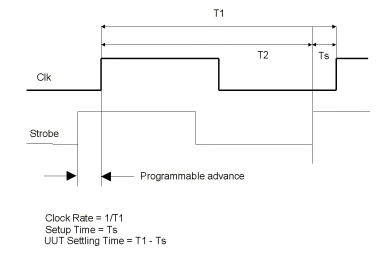
Signal Timing Diagram