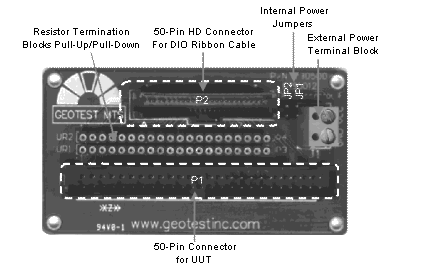
The GT95012 (the figure below) interconnects two 50-pin connectors: a high-density, 50-mil pin pitch DIO connector (P1) and a standard, 100-mil pitch UUT connector (P2).
GT95012 Connector Interface Adapter
Note: Jumpers JP1 and JP2 must be removed to apply external power at J1.
You can supply appropriate termination resistors at UR1 – UR4 in the resistor termination block sockets as required.
Internal power is applied from the DIO cable by jumping JP1 and JP2. External power is supplied at J1, which has screws that can be tightened to clamp stripped wire connections.
The interface adapter is designed to be mounted outside a host computer. It has no edge connector. Four convenient corner holes are provided for mounting on your test fixture.
The GT95012 connects to the GT25/50-DIO using the GT95002 DIO flat cable delivered with the DIO board, or with any of the other type DIO flat cables, models GT95003 through GT95007. The cable connector is placed in header P2.
Termination resistor networks are installed at UR1 through UR4. Jumpers placed at JP1 and JP2 provide power for the networks internally. External power is provided via J1.
Note: Before using external power, remove jumpers JP1 and JP2.
The Unit Under Test connects via header P1. P1 is wired pin for pin to Header P2. GT25/50-DIO I/O pin assignments are called out in the table GT5900 Carrier Configuration.
This card has two 50-pin headers that are hard-wired pin for pin. Male header P1 connects to a UUT cable. Male header P2 connects to a GT25/50-DIO cable. The GT95012 card does not support GT515X DIO boards.
UR1 – UR4 provide sockets for resistor termination packages. Power for these divider-terminators is provided through the DIO cable if JP1 and JP2 jumpers are connected, or from an external source via terminal block J1. Jumpers must be removed before connecting an external power source.
The divider center tap connects to each signal pin as follows:
UR1: pins 2, 4, 8,10, 12, 14, 18, 20
UR2: pins 3, 5, 7, 9, 13, 15, 17, 19
UR3: pins 22, 24, 28, 30, 32, 34, 38, 40
UR4: pins 23, 25, 27, 29, 33, 35, 37, 39
Terminators are not removed simply by disconnecting power. If dividers are installed, this can result in signal crosstalk. If terminators are no longer needed, remove them.