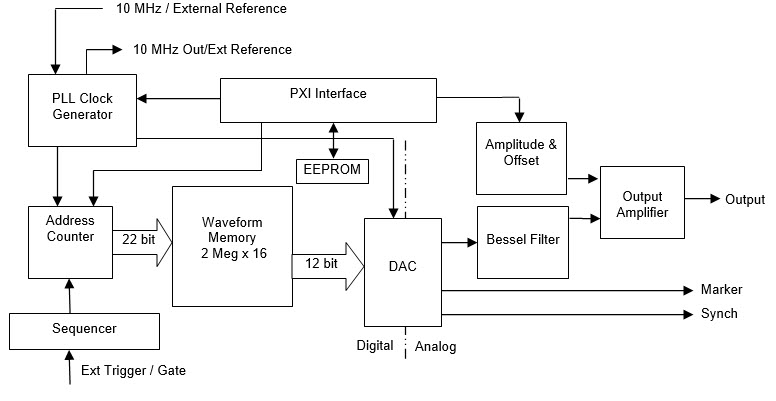
A block diagram of the GX1110 is shown in the figure GX1110 Block Diagram-AWG Mode and the figure GX1110 Block Diagram - DDS Mode illustrates the GX1120’s architecture in AWG and DDS modes. The board communicates with the host computer using the PCI interface. The software driver and application software configure board resources including the configuration / loading of the board’s FPGA for AWG or DDS mode. The board has 3 BNC connectors located on the front panel for generator output, sync output, and trigger / gate input. A 6 pin PS2 connector located on the front panel provides connections for an external AM / FM modulation input, an external clock reference input, a marker output, and a clock reference output.
A block diagram of the GX1110 is shown below in figure GX1110 Block Diagram-AWG Mode and fgure GX1110 Block Diagram - DDS Mode the GX1110’s architecture in AWG and DDS modes. The board communicates with the host computer using the PCI interface. The software driver and application software configure board resources including the configuration / loading of the board’s FPGA for AWG or DDS mode. The board has 3 BNC connectors located on the front panel for generator output, sync output, and trigger / gate input. A 6 pin PS2 connector located on the front panel provides connections for an external AM / FM modulation input, an external clock reference input, a marker output, and a clock reference output.
GX1110 Block Diagram - AWG Mode
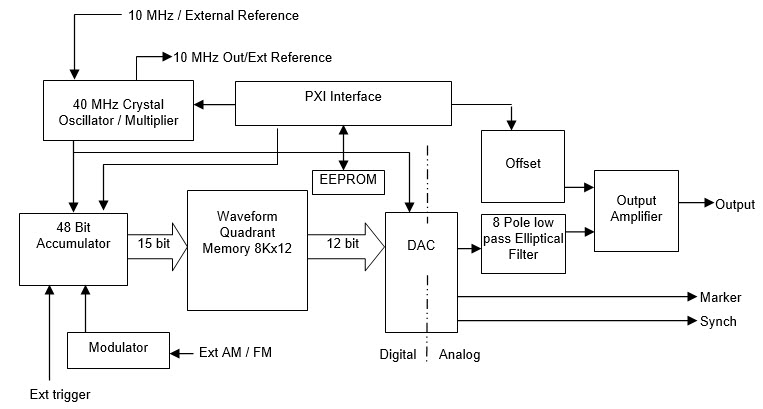
GX1110 Block Diagram - DDS Mode