
The Genasys switching sub-system has four main components: backplane, MultiMatrix™ switching cards, Switching Routers (SRs), and Rear Transition Modules (RTMs). The figure describes the block diagram of the Genasys switching sub-system. Each component is shown in a different color.
GX7016 Genasys Switching Sub-System Block Diagram
 The MultiMatrix™ switching
cards are used to connect the UUT to the system resources through a MacPanel
interface. These cards combine multiplexer and matrix architectures to
route high frequency (HF), low frequency (LF), and digital signals to
and from the UUT. There are two types of cards. The GX6192 HF
Switching and the GX6256 LF
Switching. Up to 18 cards can be install in a system. Nominal configuration
is one GX6192 and fourteen GX6256 cards.
The MultiMatrix™ switching
cards are used to connect the UUT to the system resources through a MacPanel
interface. These cards combine multiplexer and matrix architectures to
route high frequency (HF), low frequency (LF), and digital signals to
and from the UUT. There are two types of cards. The GX6192 HF
Switching and the GX6256 LF
Switching. Up to 18 cards can be install in a system. Nominal configuration
is one GX6192 and fourteen GX6256 cards.
 The switching routers are
routing the 16 between the different slots while keeping stubs length
to a minimum. Each SR supports nine slots; 2-10 and 11-19.
The switching routers are
routing the 16 between the different slots while keeping stubs length
to a minimum. Each SR supports nine slots; 2-10 and 11-19.
 The
rear transition modules connect the LF system resources to the switching
sub-system. Each RTM supports 32 input channels that it can route to any
of the 16 global bus signals.
The
rear transition modules connect the LF system resources to the switching
sub-system. Each RTM supports 32 input channels that it can route to any
of the 16 global bus signals.
 The backplane is a special
PXI backplane with provision to support up to four RTMs, two SRs and up
to 18 MultiMatrix™ switching cards.
The backplane is a special
PXI backplane with provision to support up to four RTMs, two SRs and up
to 18 MultiMatrix™ switching cards.
The GX6256 comprises of sixteen 1:4 input selectors, eight 4x8 matrices, sixteen 3:2 selectors, and sixteen 2x16 multiplexer groups connected to 256 channels. The switch matrix is essentially a 16x16 matrix implemented as eight 4x8 matrices to reduce stubs length. The row selector and input selector help in facilitating this architecture.
In order to reduce stubs length, the actual implementation divides the group to two sets of eight channels each. Channels 1-8 are the ‘Lo’ channels and 9-16 are the ‘Hi’ channels. Another feature implemented in the design is a Build-In Test circuit (BIT). By connecting a pull-up and a level sensor to one input of a pair, and a pull down to the other input, the activation of all the groups’ relays can be verified.
The figure describes the switching sections of the GX6256. Each section is shown in a different color.
There are eight 4x8 switch
matrices. The matrices columns are routed to the input channels and the
rows are routed to multiplexer groups via the selectors.
The input selector switches
an Input channel from the global switching bus in the backplane to one
of four groups of rows: A-D, E-H, I-L, M-P. The figure FSchematic
Diagram for Selectors 4 includes a logic schematic of an input selector.
 The row selector switches
a pair of multiplexer groups to one of two sets of columns: 1-8 or 9-16
or to a digital input. Figure Schematic
Diagram for Selectors includes
a logic schematic of a row selector. The row selector can also connect
the row to the BIT circuit.
The row selector switches
a pair of multiplexer groups to one of two sets of columns: 1-8 or 9-16
or to a digital input. Figure Schematic
Diagram for Selectors includes
a logic schematic of a row selector. The row selector can also connect
the row to the BIT circuit.
The
multiplexer has 16 switching groups, A-P. Each group has 16 output channels.
In order to reduce stubs length, the actual implementation divides the
group to two sets of eight channels each. Channels 1-8 are the ‘Lo’ channels
and 9-16 are the ‘Hi’ channels.
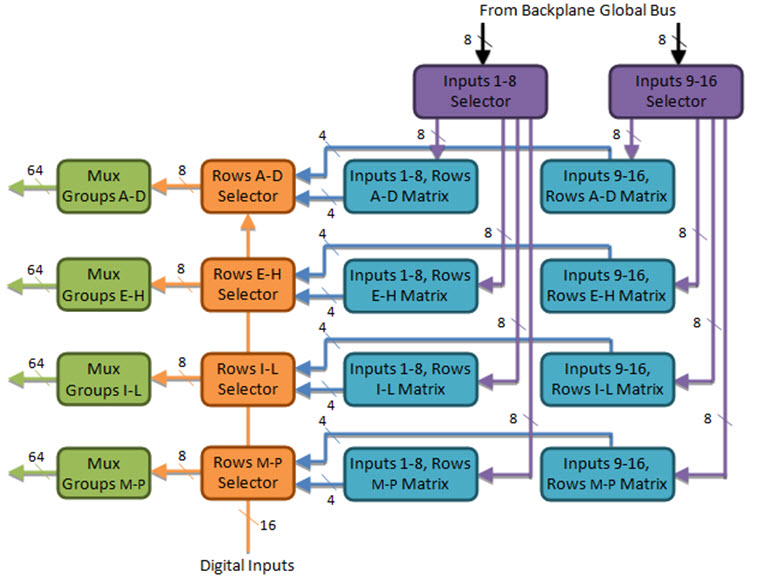
Block Diagram of the Switching Sections of the GX6256
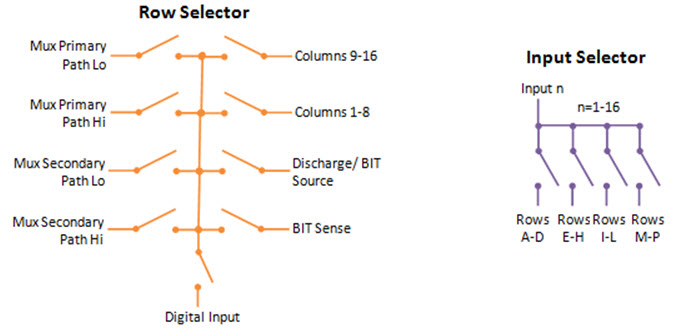
Schematic Diagram for Selectors
The GX6192 comprises of sixteen 1:4 input selectors, eight 4x8 matrices, sixteen 2:2 selectors, and sixteen 1x12 multiplexer groups connected to 192 channels. The switch matrix is essentially a 16x16 matrix implemented as eight 4x8 matrices to reduce stubs length. The selector and input selector help in facilitating this architecture.
The figure below describes the switching sections of the GX6192. Each section is shown in a different color.
There
are eight 4x8 switch matrices. The matrices columns are routed to the
input channels and the rows are routed to multiplexer groups via the selectors.
The
input selector switches an Input channel to one of four groups of rows:
A-D, E-H, I-L, M-P. The figure below includes a logic schematic of an
input selector.
The row selector switches
a multiplexer group to one of two sets of columns: 1-8 or 9-16. Figure
Schematic
Diagram for Selectors of the GX6192 includes a logic schematic of
a row selector. The row selector can also connect the row to the corresponding
global bus line in the backplane.
The multiplexer has 16 switching
groups, A-P. Each group has 12 output channels. In order to reduce stubs
length, the actual implementation divides the group to two sets of six
channels each. Channels 1-6 are the ‘Lo’ channels and 7-12 are the ‘Hi’
channels.
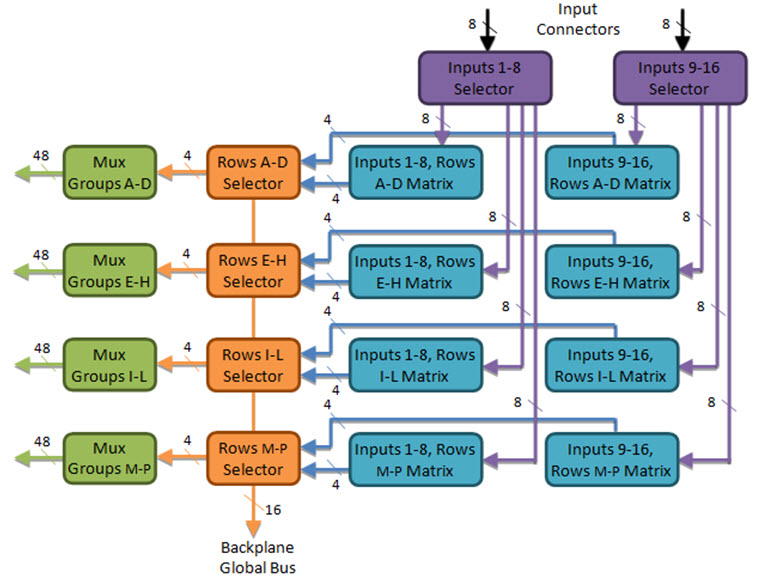
Diagram of the Switching Sections of the GX6192
Schematic Diagram for Selectors of the GX6192
The GX6864 comprises of BIT and BP connection, four 4x8 matrices, four 4:2 input selectors, and four 2x16 multiplexer groups connected to 64 channels. The switch matrix is essentially a 16x8 matrix implemented as four 4x8 matrices to reduce stubs length. The selector The GX6864 comprises of BIT and BP connection, four 4x8 matrices, four 4:2 input selectors, and four 2x16 multiplexer groups connected to 64 channels. The switch matrix is essentially a 16x8 matrix implemented as four 4x8 matrices to reduce stubs length. The selector helps in facilitating this architecture.
The multiplexer has four switching groups, A-D. Each group has 16 output
channels. In order to reduce stubs length, the implementation is done
using 1:2 multiplexers as building blocks. A total of 15 such multiplexers
are used for each input. The figure below includes a schematic of a multiplexer
group. Each of the inputs has its switching path shown in a different
color.
The input selector is integrated in the mux group and it selects for each
group the source of each input – input connector or global bus. Figure
Schematic
Diagram for Switching Blocks of the GX6864 includes a logic schematic
of an input selector.
There are four 4x8 switch matrices. The matrices columns are routed to
the global bus channels and the rows are routed to multiplexer groups
via the input selectors.
The BIT and BP connection connects the global bus signals from the backplane
to the matrix. By selecting the global bus as input to the mux group BIT
can be performed on the mux relays’ contacts. The figure Schematic
Diagram for Switching Blocks of the GX6864 includes a logic schematic
of one signal in the BIT and BP connection.
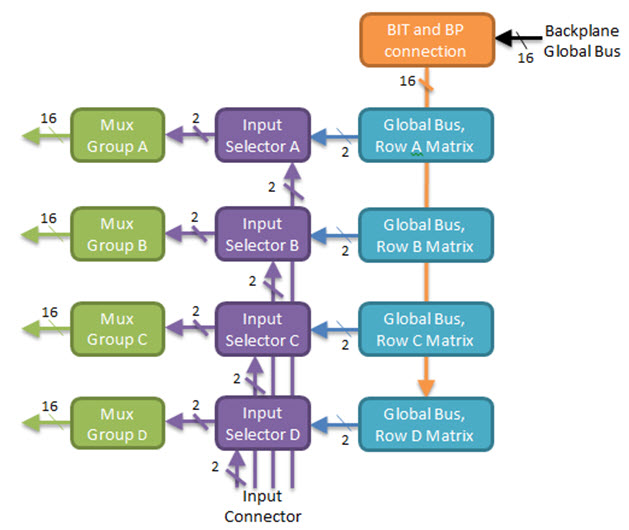
Diagram of the Switching Sections of the GX6864
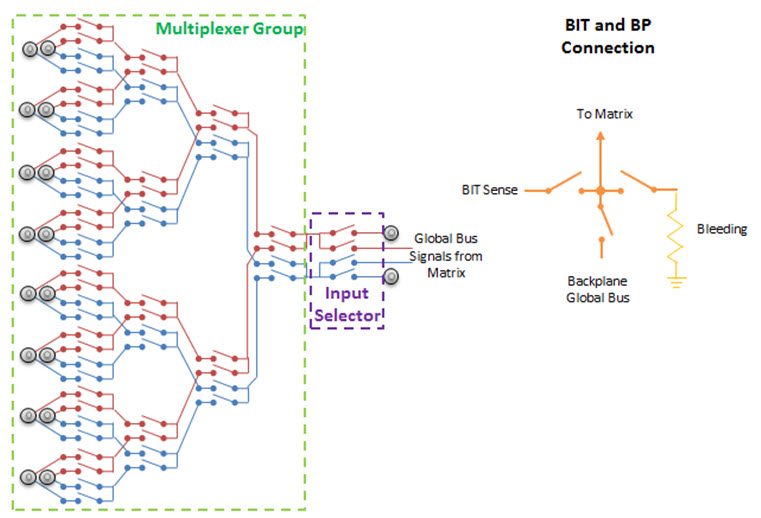
Schematic Diagram for Switching Blocks of the GX6864
The RTM comprises of 32 1:2 input selectors, 16 4x8 matrices, and 16 1:8 selectors. The switch matrix is essentially a 32x16 matrix implemented as 16 4x8 matrices to reduce stubs length. The row selector and input selector help in facilitating this architecture. The RTM board is installed on the rear of the GX7016 backplane and is controlled by the GX6256 or GX6192 connected in the matching, opposite location on the backplane via a through hole P5 connector. RTMs which do not have a module installed in the opposite location cannot be controlled by software. RTM boards can be installed on the reverse of slots 2 through 20 but chassis configuration options may physically limit which slots can support RTM installation and rear panel access. Check with MTS sales for additional configuration options.
The following figure describes the switching sections of the GX6032. Each section is shown in a different color.
There are 16 4x8 switch matrices.
The matrices columns are routed to the input channels and the rows are
routed to the global bus via the selectors.
The input selector switches
an Input channel from a BNC connector to one of two groups of columns:
1-8, 9-16. These numbers
are related to the global bus signals. Figure Schematic
Diagram for RTM Selectors of the GX6032 includes a logic schematic
of an input selector.
The column selector switches
a global bus signal to one of eight sets of rows: 1-4, 5-8, 9-12, 13-16,
17-20, 21-24, 25-28 or 29-32. These numbers are related to the input channels.
Figure Schematic
Diagram for RTM Selectors of the GX6032 includes a logic schematic
of a row selector.
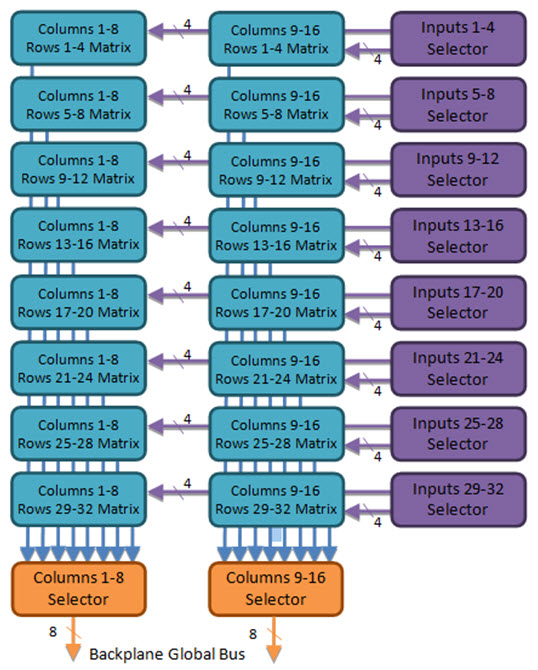
Block Diagram of the Switching Sections of the RTM
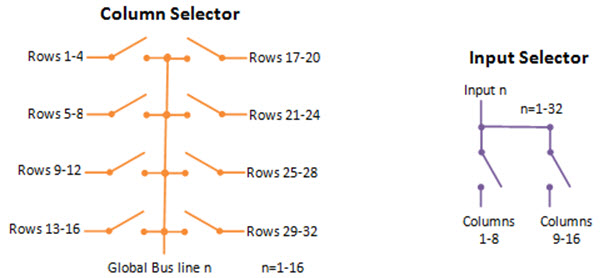
Schematic Diagram for RTM Selectors of the GX6032
The Switching router routes the 16 lines of the global bus between the slots. Each one of the bus lines routing consists of four switching groups, with four relays each. Three groups are slot switching groups and one is the common switching group. The SR board is installed on the rear of the GX7016 backplane and is controlled by the GX6256 or GX6192 connected in the matching, opposite location on the backplane via a PCB connection. Up to two SR boards can reside on the GX7016 backplane and must be controlled by switching cards in slots 2 for the first segment (slots 2 to 10) or slot 11 for the second segment (slots 11 to 19). If a GX6256/GX6192 is not installed in slot 2 or 11, the associated SR cannot be controlled by software.
The following figure shows a schematic of one bus line implementation in the SR. Three of the relays in a slot group are connected to slots and the fourth is connected to the common group. Three of the relays in the common group are connected to slot groups and the fourth is connected to the other SR board.
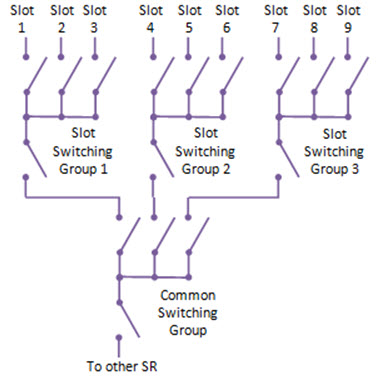
Schematic Diagram for One Bus Signal of the Switching Router