
Caution - Do not insert or remove any board while the computer is on. Turn off the power from the PXI chassis before installation.
● Install the GTDIO software as described in the prior section.
● Configure your PXI/PC system using PXI/PCI Explorer as described in the prior section.
● Verify that all the components listed in the packing list (see previous paragraph) are present.
To reduce the risk of damage to the board, the following precautions should be observed:
● Leave the board in the anti-static bags until installation requires removal. The anti-static bag protects the board from harmful static electricity.
● Save the anti-static bag in case the board is removed from the computer in the future.
● Carefully unpack and install the board. Do not drop or handle the board roughly.
● Handle the board by the edges. Avoid contact with any components on the circuit board.
|
Caution - Do not insert or remove any board while the computer is on. Turn off the power from the PXI chassis before installation. |
A DIO domain has a Master and Slave boards. In order to configure a DIO domain, each board needs to have a unique number so it can be identify by the software as part of the specified domain, i.e. all Slave boards that belongs to the same Master are in the same domain.
Master The selector switch designated as “Master” sets the Master domain that the board belongs to. The adjacent selector switch (designated as “Slave”) needs to be set to 0.
Slave The selector switch designated as “Master” sets the Master domain that the Slave board belongs to. The selector switch designated as “Slave”, select the Slave number in that domain and can be set to any number from 1 to 7 for a total of 7 Slaves (number 0 is saved for the Master).
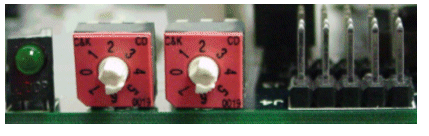
Master and Slave Switch Selectors
Timing cable needs to be installed only if there is at least one Slave board. The Timing cable provides timing and control signals to the Master and Slaves boards in the DIO domain. The Timing connection is Daisy Chain arrangement, similar to SCSI or IDE buses. The Timing cable is a flat cable with 20-pin header connectors.
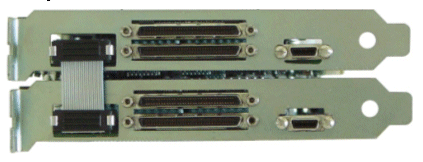
Timing Cable Interconnection
The GC5050 is shipped with the memory configuration it has been ordered with. Skip this section if you are not adding or reconfiguring the memory of the GC5050.
This section covers SIMMs (single in-line memory modules) used for data and control memory functions.
Note: DIO SIMM modules are specially made for Marvin Test Solutions in order to match the DIO’s unparallel high performance stand-alone capabilities.
GC5050 DIO boards use three SIMMs (in the figure below):
● SIMM1 – is the Control Memory
● SIMM2 – is the Output Memory
● SIMM3 – is the Input Memory
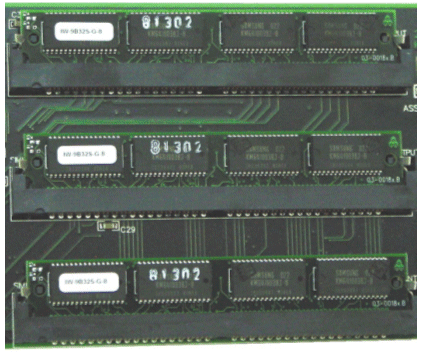
Memory and Sockets
When upgrading memory, all DIO SIMMs must have the same size and speed specifications.
Domain performance is limited by the slowest and smallest memory on any DIO board. Therefore, the user is urged to compare test requirements against DIO board memory capabilities and upgrade DIO boards as necessary. This must be done before installing boards.
The following procedure explains how to install SIMMs on a DIO board. This procedure must be implemented with the DIO board removed from the PCI chassis / PC and laying component side up on a suitable bench or work area. Observe safety and ESD precautions to avoid damage.
If populating memory with all new SIMMs, use SIMM Options table.
Carefully set the SIMM over the socket to check orientation. Make certain the SIMM edge connector is aligned with the 72-pin socket. The off-center gap between pins should match. If necessary, rotate the SIMM to align with the socket.
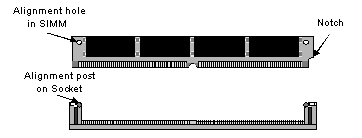
SIMM Module
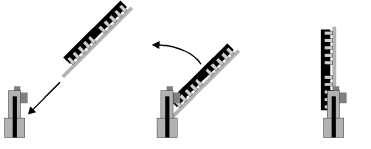
SIMM Module Installation
With the SIMM aligned and normal to the board, press firmly and rotate downward to a 45-degree angle until it snaps into place. When properly seated, the module “clicks” into place.
Assure that all SIMMs are seated correctly and that the metal locking tabs engage on both sides of the SIMM socket.
Notes: (1) Never force a SIMM into a socket. It is keyed with a notch in the lower right corner. This notch prevents incorrect orientation. If there is difficulty inserting a SIMM, check the alignment.
(2) Damage to SIMM modules and/or sockets may result if proper insertion guidelines are not observed.
(3) SIMMs are extremely sensitive to static electricity. Follow instructions near the beginning of this chapter under Discharge Static Electricity Precautions.
GC5150 DIO memory options are listed in the table below:
SIMM Part number |
Memory Size & Speed |
GC5006 |
256K, 50MHz |
GC5001 |
1MB, 50MHz |
The GC5050 is shipped with the I/O Module it has been ordered with. Skip this section unless installing or changing an I/O Module.
I/O Module daughter cards provide special interface functionality between DIO and a UUT, including signal level conversion and high drive power for cables. GC5050 DIO boards require an I/O Module to interface with a UUT. A user-selected module is factory installed and tested. For simple five-volt or 3.3Volt logic, use the GC5910 TTL I/O Module, which uses single-ended 3.3V logic. See the GT I-O Modules and Interfaces User's Guide (ISA) for more information.
When a DIO board is ordered with an I/O Module, the module is factory installed and tested. Sometimes, however, it is necessary to change the I/O interface or replace one that has been damaged. An I/O Module can be ordered separately and includes mounting hardware.
To replace an I/O Module on a GC5050 do the following:
1. Disconnect the Timing Cable from the front plate.
2. Remove the GC5050 board out from the PC/PCI chassis.
3. If the GC5050 board is mounted on a GTXI PCI Carrier board (e.g. GT7720) dismount the GC5050 board from the Carrier board.
4. On the front plate remove the I/O connector screws.
5. Remove the middle plastic screw at the edge of the I/O Module.
6. Replace the I/O Module with the new one and press the two connectors, J9 and J10 in place.
7. Install the middle plastic screw at the edge of the I/O Module.
8. Install the screws of the I/O connector in the front panel.
9. If the GC5050 board was mounted on a GTXI PCI Carrier board (e.g. GT7720) assemble the GC5050 board on the Carrier board.
10. Reattached the Timing Cable See Connecting Timing cable above.