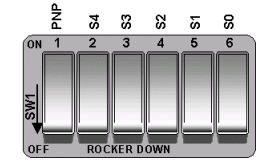
Setting the I/O Address DIP Switch
Use DIP switches S0 – S4 (See the figure above) to set a unique I/O (base) address for each DIO board. This provides enough address combinations for up to 31 boards.
GTXI platforms, have virtually unlimited I/O address space because each GTXI carrier has its own configurable offset address.
The actual address is determined from the following table. The table below shows pre-assigned base addresses. Switch positions use ON for “0” and OFF for “1” (Rocker Down).
Switch Setup S[4-3-2-1-0] |
Hex Base Address |
Switch Setup S[4-3-2-1-0] |
Hex Base Address |
1-1-1-1-0 |
100 |
0-1-1-1-0 |
300 |
1-1-1-0-1 |
110 |
0-1-1-0-1 |
310 |
1-1-1-0-0 |
120 |
0-1-1-0-0 |
320 |
1-1-0-1-1 |
130 |
0-1-0-1-1 |
330 |
1-1-0-1-0 |
140 |
0-1-0-1-0 |
340 |
1-1-0-0-1 |
150 |
0-1-0-0-1 |
350 |
1-1-0-0-0 |
180 |
0-1-0-0-0 |
380 |
1-0-1-1-1 |
190 |
0-0-1-1-1 |
390 |
1-0-1-1-0 |
200 |
0-0-1-1-0 |
700 |
1-0-1-0-1 |
210 |
0-0-1-0-1 |
710 |
1-0-1-0-0 |
220 |
0-0-1-0-0 |
720 |
1-0-0-1-1 |
230 |
0-0-0-1-1 |
730 |
1-0-0-1-0 |
240 |
0-0-0-1-0 |
740 |
1-0-0-0-1 |
250 |
0-0-0-0-1 |
750 |
1-0-0-0-0 |
280 |
0-0-0-0-0 |
780 |
0-1-1-1-1 |
290 |
1-1-1-1-1 |
Not Used |
A Master board requires 32 free I/O addresses. Slaves can use any free base address in the table either less or greater by 0x20 than a Master board’s. For example, if a Master has base address 0x310, the next higher address available for a Slave (or any device) is 0x330.
When using addresses starting with 7 (700 through 780), the corresponding addresses starting with 3 (3XX) must be assigned to a DIO board also and not used by another ISA board. Only DIO boards can differentiate between 0x7XX and 0x3XX. For example, assigning DIO board with address 0x720, then either 0x320 will not be used or may be used by another DIO board only.
Note: The “PNP” DIP Switch position (see the figure Setting the I-O Address DIP Switch) is intended for drivers that support Plug ‘n Play. The current driver does not support Plug ‘n Play. Currently, this switch must be set to the ON position (inactive) or the board may not initialize properly.
Check the README.1ST file on your installation diskette. If Plug ‘n Play is supported, enable it by turning the PNP switch to OFF (active position) and skip the switch setup.
Skip this section if you are not adding or reconfiguring memory.
This section covers SIMMs (single in-line memory modules) used for data and control memory functions.
Note: DIO performance with SIMMs not purchased through Marvin Test Solutions cannot be guaranteed.
GT515x DIO boards use nine SIMMs. SIMM9 (see the figure below) is the Control Memory. SIMM1 – SIMM8 holds Data Memory. SIMM9 (Control) and SIMM1 are the minimum needed for board operation. The Control SIMM occupies the bottom slot.
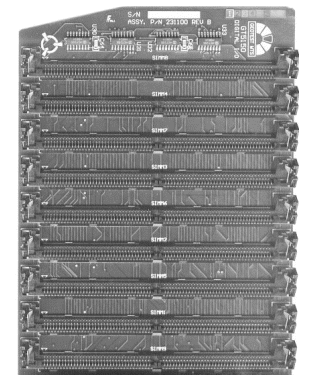
Memory Slots. Install SIMMs in the order specified
Note: DIO SIMM modules appear like those commonly used in PCs, but in fact, are different. SIMM modules used in PCs do not function on DIO boards.
When upgrading memory, all DIO SIMMs must match. The speed of a DIO board is limited by the slowest SIMM on that board.
Domain performance is also limited by the slowest and smallest memory on any DIO board. Therefore, the user is urged to compare test requirements against DIO board memory capabilities and upgrade DIO boards as necessary. This is best done before installing boards.
The following procedure explains how to install SIMMs on a DIO board. This procedure must be implemented with the DIO board removed from the host machine and laying component side up on a suitable bench or work area. Observe safety precautions to avoid damage.
1. If populating memory with all new SIMMs, use the table SIMM Options.
2. If adding to existing memory, select SIMMs identical to the type already installed.
3. Install each SIMM after SIMM 9 (Control) into the lowest numbered vacant socket. Sockets are not located in sequential order, so check the board slot labeling.
4. Carefully set the SIMM over the socket to check orientation. Make certain the SIMM edge connector is aligned with the 72-pin socket. The off-center gap between pins should match. If necessary, rotate the SIMM to align with the socket.
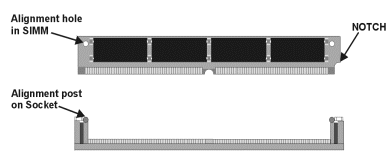
SIMM Module Installation
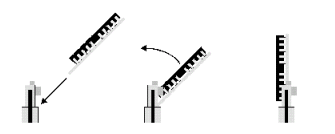
SIMM Module Installation- Side View
5. With the SIMM aligned and normal to the board, press firmly and rotate downward to a 45-degree angle until it snaps into place. When properly seated, the module “clicks” into place.
6. Assure that all SIMMs are seated correctly and that the metal locking tabs engage on both sides of the SIMM socket.
Notes: (1) Never force a SIMM into a socket. It is keyed with a notch in the lower right corner. This notch
prevents incorrect orientation. If there is difficulty inserting a SIMM, check the alignment.
(2) Damage to SIMM modules and/or sockets may result if proper insertion guidelines are not
observed.
(3) SIMMs are extremely sensitive to static electricity. Follow instructions near the beginning of this
chapter under Discharge Static Electricity Precautions.
GT515x DIO memory options are listed in the table below.
SIMM Part |
Memory Size & Speed |
Maximum Board Steps |
||
8-Chan |
16-Chan |
32-Chan |
||
GT5006-25* |
256K, 25MHz |
8M |
4M |
2M |
GT5006-50 |
256K, 50MHz |
8M |
4M |
2M |
GT5001-25* |
1MB, 25MHz |
32M |
16M |
8M |
GT5001-50 |
1MB, 50MHz |
32M |
16M |
8M |
GT5002-25* |
2MB, 25MHz |
64M |
32M |
16M |
GT5002-50 |
2MB, 50MHz |
64M |
32M |
16M |
GT5004-25* |
4MB, 25MHz |
128M |
64M |
32M |
GT5004-50 |
4MB, 50MHz |
128M |
64M |
32M |
* GT515x DIO boards are capable of 50MHz clock operation. Using a 25MHz SIMM on any DIO board can limit the domain operating clock rate to 25MHz.
Skip this section unless installing or changing an I/O Module.
I/O Module daughter cards provide special interface functions between a DIO and a UUT, including signal level conversion and high drive power for cables. GT515x DIO boards require an I/O Module to interface with a UUT. A user-selected module is factory installed and tested. For simple five-volt logic, use the GT5910 TTL I/O Module, which uses single-ended +5V logic. See the GT I-O Modules and Interfaces User's Guide (ISA).
When a DIO board is ordered with an I/O Module, the module is factory installed and tested. Sometimes, however, it is necessary to change the I/O interface or replace one that has been damaged. An I/O Module can be ordered separately and includes mounting hardware.
Note: An I/O Module should be installed with the provided standoffs to assure connectors are oriented properly. Incorrect orientation prevents the computer from booting.
I/O Modules mount on the DIO board with component sides facing each other. To mount an I/O Module, do the following:
1. From the trace side, insert the two plastic mounting screws provided into the I/O Module mounting holes.
2. Insert both standoffs over the two screws and hold them in place.
3. Insert the screws protruding from the standoff into the mounting holes on the DIO I/O board component side.
4. Press the I/O Module 100-pin header into the mating header of the DIO I/O board.
5. On the trace side of the DIO I/O board, fasten the I/O Module by tightening the plastic nuts provided on the protruding screws. Do not over tighten!
The DIO board is now ready to be reattached to the Timing Cable and inserted into an ISA slot. See General Installation Procedure above. To dismount an I/O Module, reverse this procedure.
When the GT5105 Timing Module is factory installed, skip this procedure. Perform this procedure when replacing a Timing Module or converting a Slave board to a Master.
The GT5105 has two 20-pin Timing cable connectors at the top. Both connectors have identical signals. The Timing cable provides timing and control signals to Master and Slave IO Modules. The Timing cable is daisy-chain arrangement, similar to SCSI or IDE buses.
To reduce propagation delay, the Master should be located near the center of the domain. DIO Boards employ diodes to clip ringing rather than resistive terminators, so a cable termination is not necessary. (GT25/50-DIO boards do use cable termination resistors.)
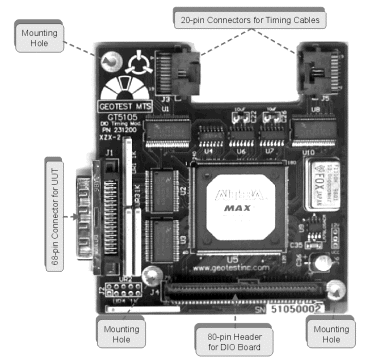
GT5105 Timing Module
The GT5105 mounting kit includes the card, mounting hardware and a two-foot UUT timing cable with VHD connectors.
To mount a GT5105 Timing Module, do the following:
1. Unscrew the DIO board’s end bracket and remove it. Save the metal screws.
2. Unscrew the four guide pin sockets securing the 68-pin and 14-pin DIO connectors to the end plate. Save the sockets.
3. Remove the end plate.
4. Insert the three mounting screws provided through the three mounting holes on the trace side of the GT5105. Insert Teflon standoffs over the screws on the component side so that the mounting screws protrude over the standoff.
5. Align the mounting holes on the DIO I/O board with the three mounting screws and rest them over the standoffs.
6. Press the GT5105’s 80-pin header into the mating header on the DIO I/O board.
7. On the trace side of the DIO board, secure the three mounting screws with the nuts provided. Tighten the screws, but do not over tighten!
8. Reattach the motherboard’s mounting bracket using the screws removed in step 1.
9. Reattach the four guide pin sockets to the end bracket.
10. Attach appropriate Timing cables as described in the General Steps for PC Installation above. One of the Timing cables must connect the GT5105 (J3) to the motherboard (J5).
The Timing Module is now mounted and ready to connect to Slave modules (see General Installation Procedure above).
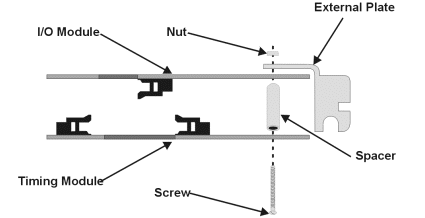
Timing Control Module Installation - Side View
For GTXI (GTXI-700 or GT7700) installations, the DIO board must be installed in a GTXI ISA carrier (GT7020) before inserting into the GTXI chassis. (This carrier is different from the GT5900 carrier discussed earlier). All domain boards must be removed before installing or reconfiguring any domain board.
Because of limited access from the top of the chassis, the ribbon Timing cable must be connected from the Master to all Slave boards before inserting the boards into the chassis. This is achieved by stringing the cable among DIO boards through perforations in the carrier. Timing cables vary in length depending on number of slaves. A cable of the proper length may be obtained from Marvin Test Solutions.
The timing cable restrains the distance each carrier can move. Align all carriers with upper and lower GTXI card guides, and then carefully move all as a group toward the rear GTXI connectors.
Note: When removing any DIO carriers in a domain, all must be removed from the GTXI at the same time. The ribbon cable and connector can be damaged by failure to remove any DIO carrier with the others.
Marvin Test Solutions provides a dual GTXI carrier board that accepts a Master and Slave DIO board. This special carrier board allows two DIO boards to be inserted and removed as a single unit. Contact Marvin Test Solutions for more information about this product.
For configurations having more than two DIO boards, Marvin Test Solutions can provide long handles to gang the front panels of GTXI carriers. This simplifies installation and avoids possible damage when removing multiple boards. Marvin Test Solutions technical support can recommend the correct handle replacement and provide special guidelines for multiple DIO boards in GTXI systems.
The user may want to call DIO technical support when installing multiple DIO boards in a GTXI chassis for the first time.